Aug.17,2026
Share:
How much does a padel court cost to build? For a commercial padel project, a realistic planning range is approximately $25,000–$65,000 or more per court once the court equipment and installation are considered.
According to published 2026 industry cost guides, a complete outdoor padel court in the U.S. can cost approximately $40,000–$75,000 when the court system, slab, lighting, freight, and installation are included, while other estimates place the court structure itself at around $30,000–$50,000, with professional installation adding another $5,000–$15,000.
For project owners looking to control their initial investment, sourcing a custom padel court directly from a Chinese manufacturer can provide a more cost-effective alternative. Chinese padel court manufacturers can provide complete customized court packages directly from the factory, factory-direct sourcing can reduce equipment procurement costs while still allowing the court to be customized around the project’s dimensions, design requirements, playing environment, and commercial positioning.
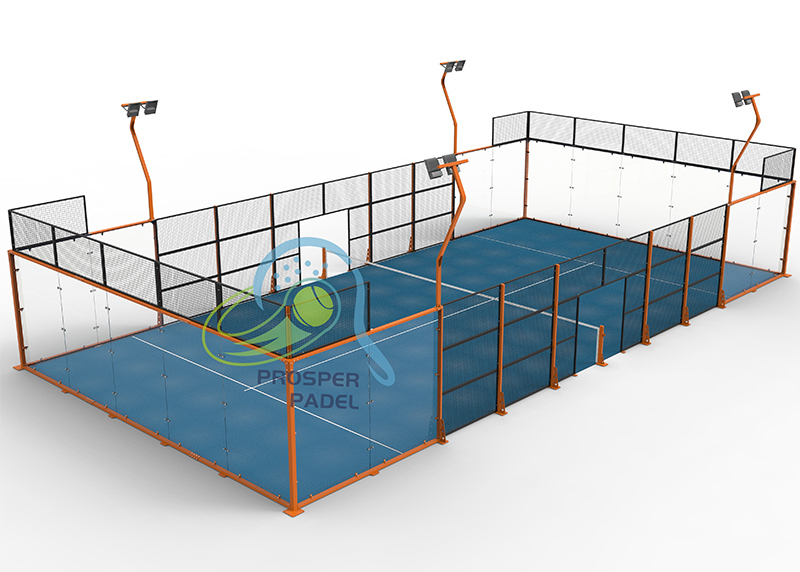
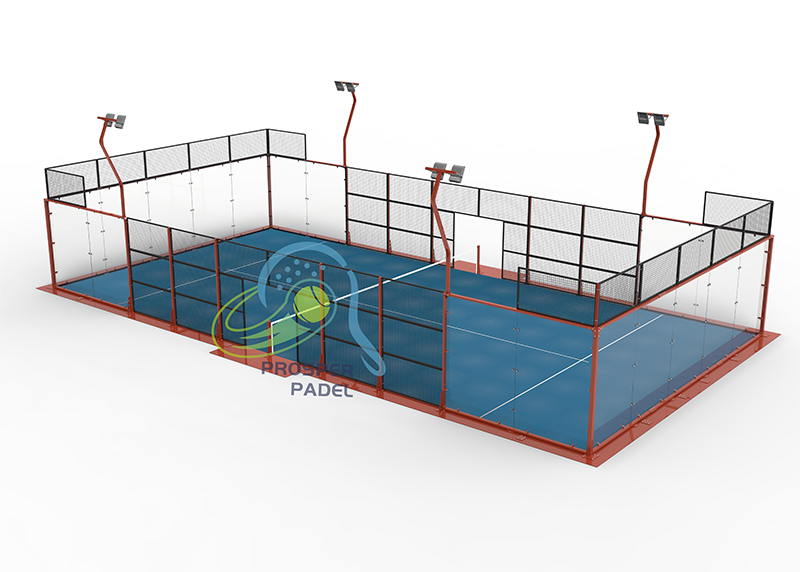
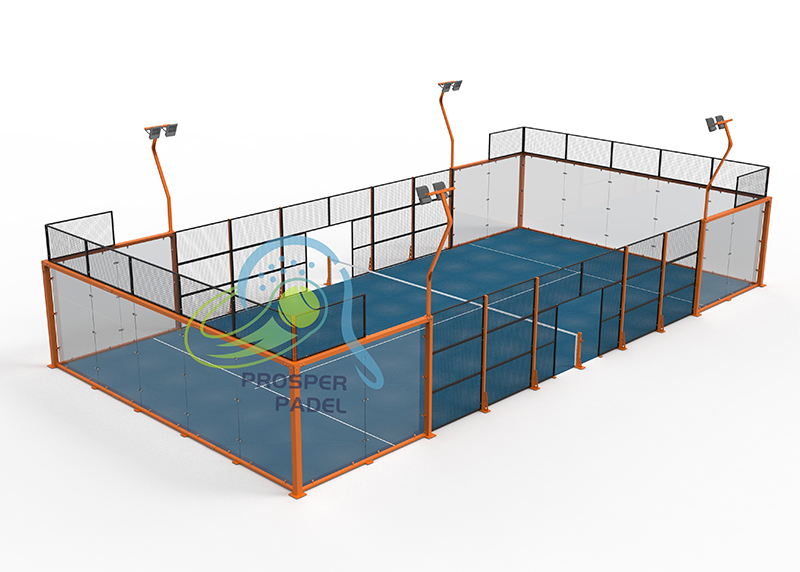
A Chinese padel court manufacturer can typically supply a complete customized package covering the steel structure, tempered glass, artificial turf, lighting system, net system, fasteners and accessories, together with options for court dimensions, structural design, colors, branding, lighting configuration, and other project-specific requirements. Design support, production, packaging, international shipping coordination, and installation guidance can also be integrated into one supply process.
This allows clubs, sports facilities, distributors, and project contractors to source a complete padel court system from one supplier while reducing procurement complexity and overall equipment costs.
There is no single global price because labor costs, construction standards, transportation, climate requirements, and site conditions vary significantly between countries.
As a general 2026 reference:
| Project Type | Indicative Budget Level |
|---|---|
| Basic court equipment on a prepared site | Lowest-cost option |
| Standard outdoor commercial court | Approximately $25,000–$45,000+ |
| Panoramic or higher-specification court | Approximately $35,000–$65,000+ |
| Court with significant foundation and site work | Often $50,000+ |
| Covered or complex turnkey project | Can exceed $70,000–$100,000 per court equivalent |
These figures should be treated as planning ranges rather than supplier quotations.
For comparison, one 2026 European construction guide estimates approximately €18,000–€35,000 for outdoor courts and €40,000–€60,000 for more complex indoor or panoramic projects. Another construction supplier places average padel court construction at approximately $39,800–$45,300, depending heavily on foundation requirements.
Official UK guidance demonstrates how dramatically civil works can change the final figure. The LTA currently estimates one court with lighting at about £36,000, while the ring beam, base, and drainage add approximately £35,000, taking the total reference cost to around £71,000 for one court.
That difference is why buyers should always separate court supply cost from total project cost.
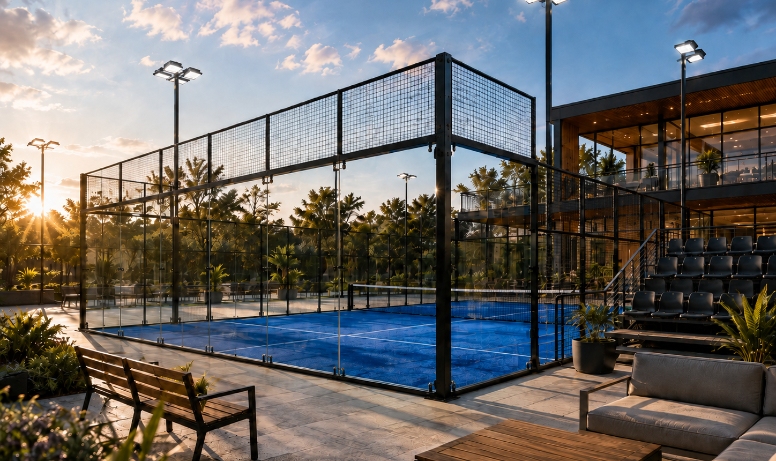
The padel court structure is normally one of the largest equipment costs.
A standard padel court includes:
structural steel frames;
metal mesh fencing;
tempered glass panels;
entrances and doors;
artificial turf;
net system;
lighting poles and fixtures;
fixing hardware and accessories.
The International Padel Federation specifies a standard doubles court with internal dimensions of 20 × 10 meters, enclosed by walls and fencing. New facilities are recommended to provide sufficient unobstructed height above the playing area.
The amount and specification of steel and glass have a direct effect on the court price.
A conventional framed court is usually more economical than a highly panoramic model because panoramic designs require different structural engineering and typically place greater emphasis on uninterrupted glass sightlines.
For clubs focused on tournaments, premium positioning, or spectator visibility, paying more for a panoramic configuration may make commercial sense. For training centers or recreational venues, a standard structure may be more cost-efficient.
This is one of the most underestimated parts of a padel project.
Even an excellent court system needs a stable and level foundation.
Depending on the site, work may include:
excavation;
grading;
concrete slab or ring beam construction;
reinforcement;
drainage;
slope correction;
waterproofing;
access preparation.
Industry cost breakdowns suggest that substructure and flooring can represent roughly 25%–30% of total construction cost, although difficult sites may push this percentage considerably higher.
An existing tennis or sports surface may reduce preparation costs if its condition and dimensions are suitable.
By contrast, undeveloped land can require significant civil work before court installation can even begin.
This explains why two identical padel courts can have very different final project costs.
One may be installed on an existing engineered slab, while another requires excavation, concrete work, drainage, and extensive site access preparation.
Steel and glass are major cost drivers in the court itself.
One 2026 industry breakdown estimates that steel construction may account for around 30%–35% of construction cost, while glass can represent approximately 15%–20%.
Price differences can result from:
steel profile dimensions;
reinforcement requirements;
corrosion protection;
coating specification;
wind-load requirements;
glass thickness;
glass certification;
panoramic versus framed structure.
Outdoor coastal installations, for example, may require stronger corrosion protection than indoor installations.
Likewise, courts installed in high-wind regions may require structural reinforcement based on local engineering standards.
The cheapest steel specification is therefore not necessarily the lowest-cost choice over the full service life of the facility.
Artificial turf represents a smaller percentage of the overall construction budget but has a major effect on playing experience.
Price varies according to:
fiber specification;
pile design;
manufacturer;
turf density;
color;
sand requirements;
installation method.
Commercial clubs should evaluate turf according to expected playing hours rather than visual appearance alone.
A private residential court may only be used several hours per week. A commercial padel club can receive bookings throughout the day and evening.
That difference matters when considering durability and maintenance.
The FIP permits synthetic and artificial-grass surfaces provided that they meet playing and surface requirements, including appropriate ball rebound and surface evenness.
Lighting is usually required for commercial courts because evening hours are often an important part of the booking schedule.
A typical system includes:
LED floodlights;
lighting poles;
wiring;
electrical cabinets or control equipment;
installation.
The fixtures themselves may represent only part of the cost.
Local electrical work, cable routing, trenching, distribution boards, and labor can make the installed lighting cost significantly higher than the equipment price alone.
Lighting should also be planned before the court is manufactured.
FIP rules require artificial lighting to be positioned so that it does not interfere with players, officials, or spectators, and the location and height of lighting fixtures must respect the playing area requirements.
For imported padel courts, transport can noticeably affect the project budget.
A court shipment can include:
long steel components;
large glass panels;
turf rolls;
lighting equipment;
nets;
fasteners;
protective materials.
Shipping cost varies according to destination, number of courts, container utilization, port charges, inland transportation, and customs requirements.
Ordering several courts together may improve the shipping cost per court because components can be consolidated more efficiently.
For this reason, clubs planning four or six courts should request a project quotation, rather than simply multiplying the shipping cost of one court.
Installation is another area where quotations differ.
Some suppliers quote only the court equipment.
Others include installation guidance, technician supervision, or full assembly.
Typical installation work involves:
checking the finished foundation;
positioning and anchoring the steel structure;
installing fencing;
fitting glass panels;
installing lighting;
laying artificial turf;
adding sand infill where required;
installing the net and accessories;
completing final alignment and inspection.
Local labor rates can create substantial differences between markets.
Before comparing suppliers, buyers should therefore ask:
Does the quotation include installation, supervision, or only equipment supply?
For outdoor padel courts, drainage should never be treated as an optional afterthought.
Rainwater must be managed around both the playing surface and surrounding foundation.
Poor drainage can lead to standing water, surface problems, foundation damage, and reduced court availability.
The cost depends on:
rainfall conditions;
existing site drainage;
soil characteristics;
surface level;
connection to stormwater infrastructure.
UK padel construction guidance specifically groups drainage together with the ring beam and court base as a major part of project cost.
This is one reason outdoor court projects may cost more than buyers initially expect.
The answer depends on whether a suitable building already exists.
If a club has an existing warehouse, sports hall, or indoor venue with sufficient clear height, the court installation itself may actually be relatively straightforward.
The major expense comes when the project requires a new building or canopy.
Then the budget may need to include:
structural steel;
roofing;
wall systems;
foundations;
drainage;
ventilation;
fire-safety systems;
electrical systems;
planning approval.
For reference, current LTA estimates place the canopy, canopy foundation, and drainage for one court at approximately £75,000 in addition to the court project itself.
This shows why an “indoor padel court price” can mean two very different things.
Installing a court inside an existing building is very different from constructing an entire covered padel venue from scratch.
Court design also changes the budget.
A standard framed court generally offers the most economical route for commercial installation.
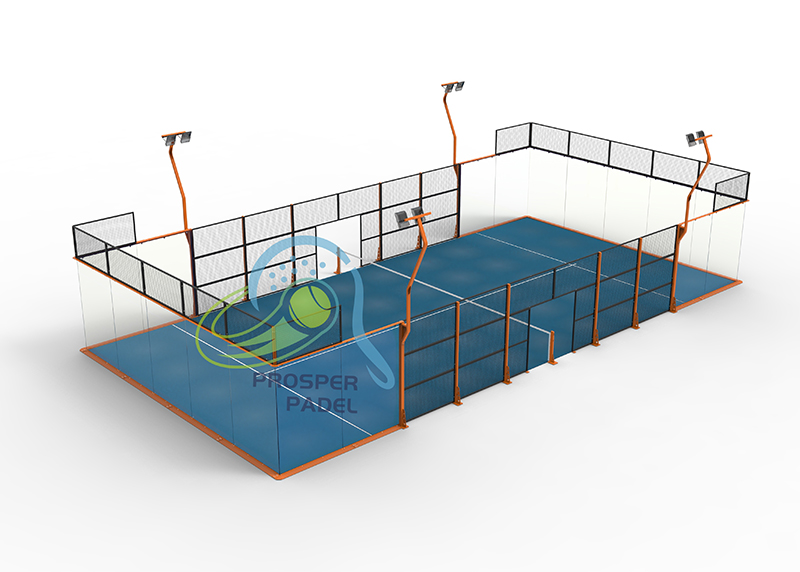
A panoramic padel court reduces the number of visible structural posts around key glass areas, improving sightlines and giving the facility a more premium appearance.
This can be useful for:
high-end commercial clubs;
tournaments;
hotels and resorts;
spectator-focused venues;
sponsorship and media environments.
The higher price should therefore be judged against the intended use of the venue.
For a training academy, investing heavily in panoramic architecture may not be necessary.
For a premium club where customer experience and visual identity are part of the business model, it may be justified.
Customization does not always increase project cost dramatically, but it should be included during initial budgeting.
Options can include court colors, turf colors, logos, different lighting-pole designs, protective elements, spectator infrastructure, and branded club details.
For example, JUZHIXIN SPORTS provides customized padel court solutions covering steel-structure colors, turf colors, logo applications, and different lamp-post configurations. Its one-stop solution can also incorporate mobile and retractable grandstand seating, which can be particularly useful for clubs that need spectator capacity during tournaments without permanently occupying valuable venue space.
Movable seating is an optional cost, but it can change how the overall facility is planned.
Instead of constructing a permanent grandstand that remains unused during normal training hours, a club can deploy seating when required and reuse the area at other times.
For multi-purpose sports venues, this flexibility should be considered as part of the overall investment rather than simply as an accessory purchase.
Building several courts normally does not mean multiplying the single-court cost exactly.
Some costs can be shared.
For example:
site mobilization;
freight;
engineering;
electrical infrastructure;
drainage;
installation supervision;
machinery;
access construction.
However, foundations and court equipment still increase with every additional court.
Current LTA planning figures illustrate this effect. Its reference total rises from approximately £71,000 for one court to £148,000 for two, £210,000 for three, and £268,000 for four courts including lighting, base work, and drainage.
Therefore, a commercial club planning several courts should request pricing based on the complete site, not just a unit price per court.
Instead of asking a supplier only:
“What is your padel court price?”
ask for the project to be divided into clear sections:
| Budget Item | Questions to Confirm |
|---|---|
| Court equipment | What structure, glass, turf and lighting are included? |
| Foundation | Is the slab or ring beam included? |
| Drainage | Who designs and installs it? |
| Freight | Is delivery to port or final site included? |
| Installation | Is labor, supervision or guidance included? |
| Electrical work | Who connects the lights and control system? |
| Permits | Who handles local approvals? |
| Customization | Which colors, logos and options are included? |
| Spectator facilities | Are seating or grandstands required? |
| Roofing | Is a canopy or building needed? |
This makes supplier quotations much easier to compare.
A $20,000 quotation and a $40,000 quotation may not actually represent the same scope.
The cheaper offer may exclude foundations, freight, installation, or lighting.
Reducing cost does not necessarily mean choosing cheaper materials.
The biggest savings often come from better project planning.
Converting an existing tennis or sports area may reduce excavation and foundation work if the existing base is structurally suitable.
Multi-court projects can spread logistics, installation, and site mobilization costs across more courts.
Changing colors, doors, lighting configurations, or structural requirements after manufacturing has started can add both time and cost.
For international projects, foundations and drainage are often completed locally.
Clear drawings and coordination between the court supplier and local contractor reduce the risk of rework.
Not every venue requires a tournament-level panoramic structure.
Choose specifications according to expected use rather than simply selecting the highest-cost option.
A commercial padel court project commonly falls somewhere between approximately $25,000 and $65,000+, but the final installed cost depends heavily on foundation work, drainage, freight, labor, court type, and local requirements. Complex projects can exceed this range substantially.
Steel construction and site preparation are usually among the largest cost categories. One current industry estimate attributes approximately 30%–35% of construction cost to steel and 25%–30% to the substructure and floor.
The equipment cost increases with every court, but multi-court projects can share freight, machinery, installation supervision, electrical infrastructure, drainage planning, and other project costs. As a result, the average cost per court may improve as the project becomes larger.
Not always. This is one of the most important questions to ask when comparing quotations. Some padel court prices refer mainly to court equipment, while others include foundation, drainage, lighting, and installation.
A covered project can cost substantially more than an outdoor court because the roof structure may require separate foundations, engineering, drainage, approvals, and structural steel. Current UK guidance estimates approximately £75,000 for a single-court canopy and its foundation/drainage, before considering the underlying court project.
So, how much does a padel court cost to build?
For early planning, a commercial buyer can reasonably expect to invest tens of thousands of dollars per court, but there is no meaningful universal price until the site, foundation, court specification, shipping destination, and installation scope are defined.
The most useful quotation is therefore not the one with the lowest headline number.
It is the one that clearly explains:
what is included, what is excluded, what must be completed locally, and what the final operational court is expected to cost.
Article data source:
For sports clubs and commercial padel centers, budgeting the entire facility—from ground preparation to opening day—provides a far more accurate picture than comparing court equipment prices alone.
Click To Get Your Exclusive Plan
Tianjin Juzhixin Sports Technology Co., Ltd is an innovative sports technology and import and export sales enterprise based in Tianjin and radiating its business worldwide. It is dedicated to empowering the development of the sports industry with technology
Contact Us
HOT Products

+86 189 2070 7687
Huamao Building, Binhai New Area, Tianjin
Copyright @ Tianjin Juzhixin Sports Technology Co., Ltd All Rights Reserved | Sitemap
| Powered by