Jul.15,2026
Share:
A standard padel court measures 20 meters long by 10 meters wide, while a doubles tennis court measures 23.77 meters by 10.97 meters — making padel roughly 23% smaller in footprint and, because padel courts are fully enclosed rather than open, up to three padel courts can fit into the space needed for a single tennis court. For clubs, hotels, and property owners comparing racquet sports investments, this size difference is the single biggest factor behind why padel facilities can generate more bookings and revenue per square meter than an equivalent tennis layout.
A regulation padel court, as defined by the International Padel Federation (FIP), has the following core measurements:
Unlike an open tennis court, these dimensions only describe the internal playing area — the enclosure itself, along with access gates and safety clearance, adds to the total footprint a facility needs to set aside.
A standard doubles tennis court is considerably larger and, unlike padel, has no walls at all:
Because tennis courts rely on open space rather than walls to keep the ball in play, the surrounding buffer zone tends to be larger than what padel requires, even though padel's enclosure itself takes up vertical space that tennis does not need.
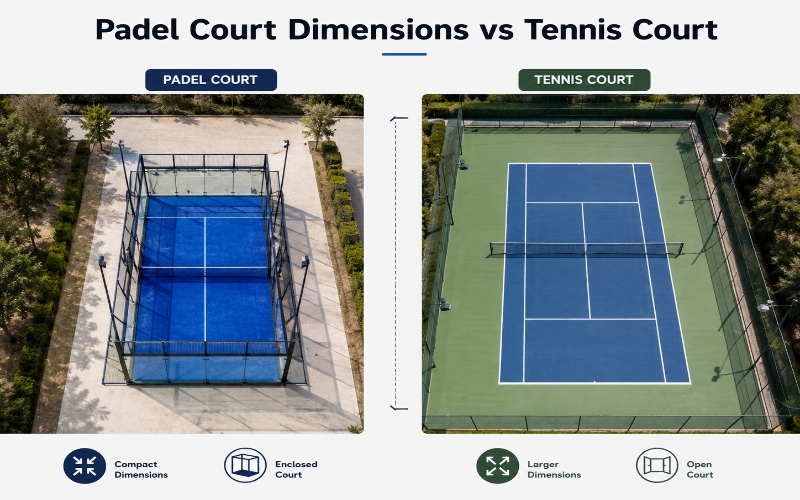
The table below lines up the two sports directly, which is the comparison most facility planners are searching for when evaluating padel court dimensions against a tennis court.
| Specification | Padel Court | Tennis Court (Doubles) |
|---|---|---|
| Length | 20m (65.6 ft) | 23.77m (78 ft) |
| Width | 10m (32.8 ft) | 10.97m (36 ft) |
| Playing area | ~200 m² | ~260.9 m² |
| Enclosure | Glass + mesh walls (3–4m) | None (open court) |
| Net height (center) | 0.88m | 0.91m |
| Net height (posts) | 0.92m | 1.07m |
| Recommended external footprint | ~23m x 13m | ~36.6m x 18.3m |
Note how a padel court's playing area is about 23% smaller than a tennis court's, but once wall structure and access clearance are factored in on both sides, the real-world space advantage of padel becomes even more pronounced — which is why so many facilities are converting underused tennis courts into two or more padel courts.
The gap between padel court dimensions and tennis court dimensions isn't just a trivia point — it directly shapes site planning, construction budgets, and long-term returns:
1.Space efficiency – A single tennis court footprint can typically accommodate two to three padel courts, multiplying the number of playable slots available in the same land area.
2.Construction cost per court – While padel's enclosure adds cost that open tennis courts don't have, the smaller footprint often results in a lower total site development cost per court when building multiple padel courts together.
3.Booking capacity – More courts in the same space means more simultaneous games, which increases the number of bookings a facility can sell across a single day.
4.Conversion potential – Because a padel court (20m x 10m) fits comfortably inside a standard tennis court (23.77m x 10.97m), many existing tennis facilities are adding padel courts onto their footprint without needing additional land.
5.Indoor feasibility – Padel's smaller playing area, combined with a recommended ceiling clearance of 6–8m, makes indoor installation more practical than trying to house a full tennis court indoors.
For any organization evaluating whether to build tennis courts, padel courts, or a mix of both, these dimension-driven factors typically outweigh material or branding decisions when it comes to projected utilization.
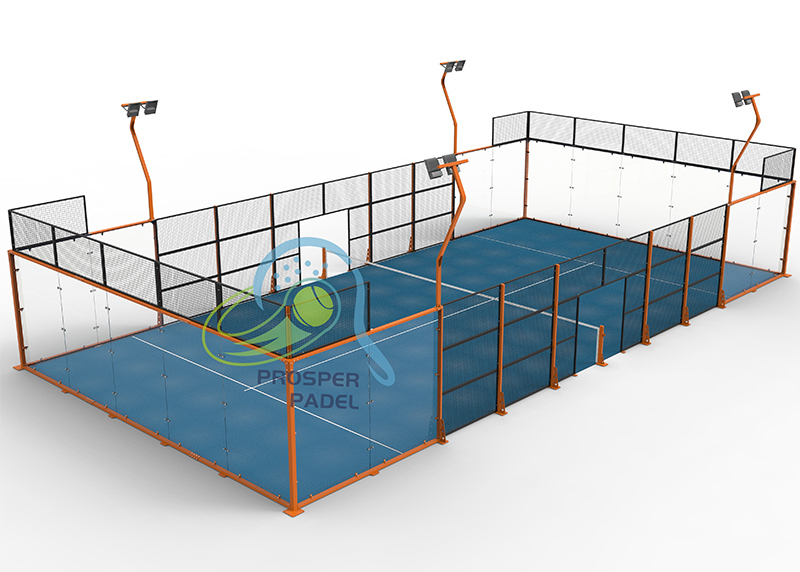
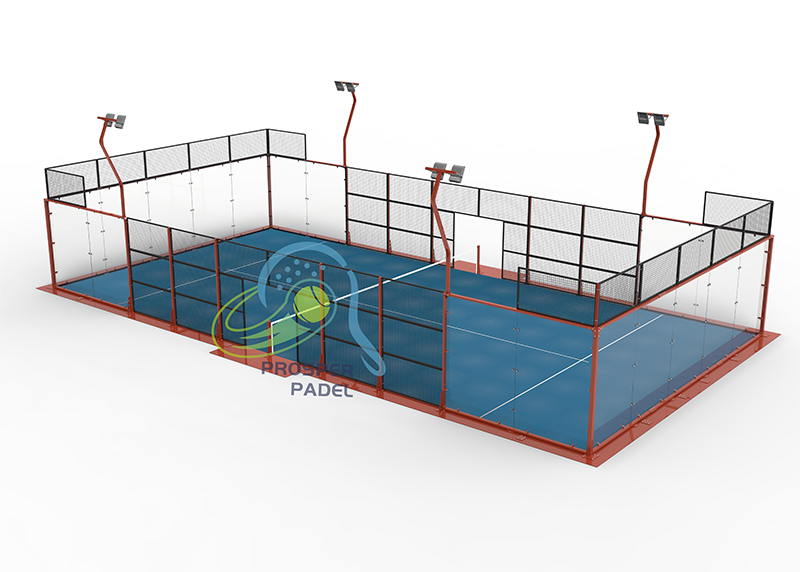
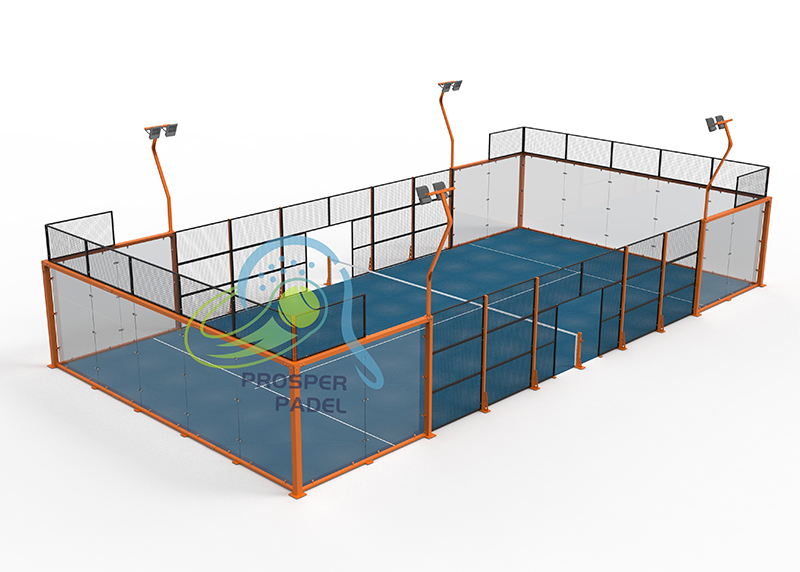
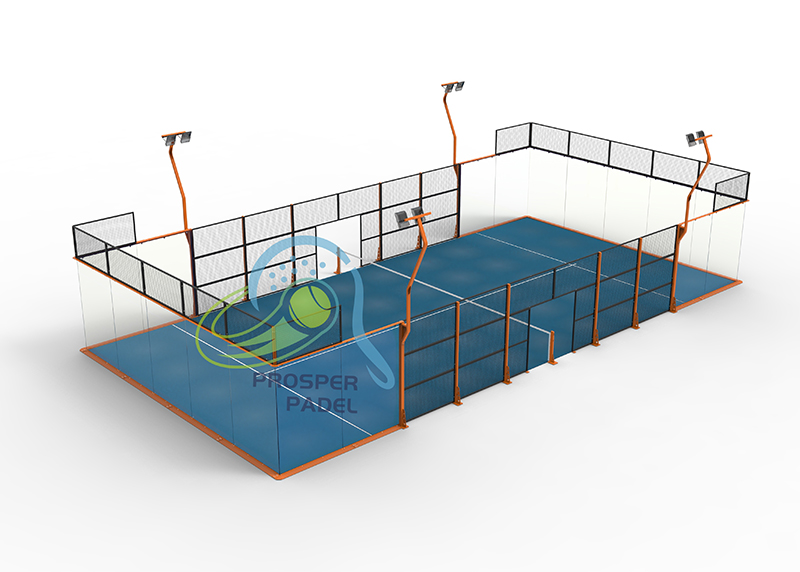
Beyond raw length and width, the most significant structural difference in the padel court dimensions vs tennis court comparison is the enclosure itself. Padel courts are built with:
Tennis courts, by contrast, need no enclosure at all — just fencing around the perimeter for ball containment, which is far less structurally demanding and less expensive per linear meter than padel's glass-and-mesh system. This is also why padel court construction budgets are weighted so heavily toward the enclosure, even though the court itself is smaller.
Neither padel nor tennis courts can be built to their bare playing dimensions alone. Additional space is needed for:
For padel, the generally recommended external footprint is at least 23m x 13m per court. For tennis, planners typically budget closer to 36.6m x 18.3m to allow proper run-off space behind the baselines and along the sidelines. This difference reinforces why padel remains the more space-efficient option for facilities with constrained land.
Comparing padel court dimensions to tennis court dimensions comes down to one central trade-off: padel's smaller, fully enclosed footprint trades some open playing space for dramatically better land efficiency, faster-paced gameplay, and the ability to fit multiple courts where a single tennis court would otherwise sit. For clubs, hotels, and developers planning a new racquet sports facility — or deciding whether to convert existing tennis courts — understanding these exact measurements is the first step toward a layout that maximizes both playability and return on space.
Depending on the exact site layout and access requirements, most facilities can fit two to three padel courts within the footprint of a single standard tennis court.
In many cases, yes. Since a padel court fits within the footprint of a tennis court with room to spare, some facilities reuse the existing slab and location, though the enclosure, turf, and net system still need to be built to padel specifications.
Padel's net sits at 0.88m at the center and 0.92m at the posts, slightly lower than tennis at 0.91m and 1.07m. This is intentional, since padel play emphasizes wall rebounds and net play over the higher-arc shots common in tennis.
Not necessarily — the enclosure (glass and mesh walls) adds cost that open tennis courts don't require. However, because more padel courts fit into the same space, the total cost and revenue potential per unit of land are often more favorable for padel.
Click To Get Your Exclusive Plan
Tianjin Juzhixin Sports Technology Co., Ltd is an innovative sports technology and import and export sales enterprise based in Tianjin and radiating its business worldwide. It is dedicated to empowering the development of the sports industry with technology
Contact Us
HOT Products

+86 189 2070 7687
Huamao Building, Binhai New Area, Tianjin
Copyright @ Tianjin Juzhixin Sports Technology Co., Ltd All Rights Reserved | Sitemap
| Powered by