Oct.16,2026
Share:
Choosing between a fixed padel court roof and a retractable padel court roof is an important decision when developing a covered padel facility. A fixed roof provides permanent overhead protection with relatively simple maintenance, while a retractable roof allows operators to switch between open-air and covered playing conditions. Both designs can help improve court availability, but their costs, structural requirements, and long-term operating needs differ.
For most commercial clubs, a fixed roof is generally the more practical choice when reliable weather protection and cost control are the priorities. A retractable roof may be more suitable for premium venues seeking flexible outdoor experiences.
Before selecting a design, buyers should consider local weather, court dimensions, budget, and operating requirements. Customizable padel court canopy solutions can provide an alternative to constructing a fully enclosed sports building.
This guide compares the two main padel court roof types and explains how to choose the right option for your project.
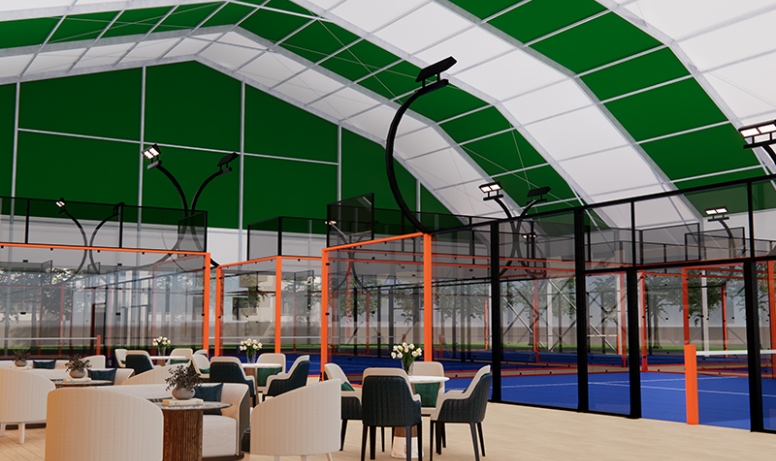
The main difference is whether the roof can be opened after installation.
A fixed padel court roof is a permanent covering structure installed above one or more courts. It typically consists of a supporting steel or aluminum frame and a fixed roofing material.
Common covering options include PVC membranes, polycarbonate panels, and metal roofing systems.
Fixed canopies can be designed with open sides or additional side coverings, depending on the level of weather protection required.
Their main advantages include:
Consistent overhead protection from rain and sunlight.
Relatively simple structural and operational requirements.
Fewer moving components requiring maintenance.
Suitability for single-court and multi-court developments.
Customizable dimensions and structural configurations.
A fixed canopy is particularly suitable for commercial sports centers, clubs, and resorts that prioritize reliable daily operations.
A retractable padel court roof uses a movable covering system that can be opened or closed according to weather conditions.
Depending on the design, the roof may operate through manual mechanisms or motorized systems using tracks, rollers, sliding panels, or movable fabric sections.
When opened, the roof allows players to enjoy a more traditional outdoor padel experience. When closed, it provides overhead shelter.
Its main advantages include:
Flexible open-air and covered playing environments.
Greater control over natural light and ventilation.
Potential appeal for premium sports and hospitality venues.
Adaptability to seasonal weather preferences.
However, these benefits come with additional mechanical components, operational requirements, and maintenance considerations.
The following comparison highlights the main factors buyers should evaluate before choosing a padel court roofing system.
| Comparison Factor | Fixed Padel Court Roof | Retractable Padel Court Roof |
|---|---|---|
| Initial Cost | Generally lower | Generally higher |
| Weather Protection | Continuous overhead coverage | Coverage when closed |
| Roof Operation | Permanently covered | Can open and close |
| Maintenance | Fewer mechanical components | More mechanical maintenance |
| Installation Complexity | Relatively straightforward | Requires moving mechanisms and controls |
| Natural Ventilation | Depends on side openings and canopy design | Greater flexibility when open |
| Customization | Flexible dimensions and covering materials | Depends on the movement system |
| Best Applications | Commercial clubs and multi-court facilities | Premium clubs, hotels, and resorts |
| Long-Term Expenses | Primarily structural and material maintenance | Structural, mechanical, and electrical maintenance |
Both designs require proper engineering, foundations, drainage, and wind-load assessment.
The better option depends on the venue's requirements rather than the roof type alone.
Fixed padel court roofs are usually more cost-effective in terms of initial investment and maintenance complexity. However, the overall project cost also depends on the roof size, foundation requirements, and installation location.
A fixed canopy generally requires a supporting frame, roof covering, foundations, anchoring, and drainage.
A retractable system requires many of the same components but adds moving mechanisms, operating equipment, controls, and potentially more complicated structural connections.
Motorized retractable roofs may also require electrical installations, sensors, and commissioning.
These additional elements generally increase the initial investment.
For budget-conscious commercial projects, fixed PVC membrane canopies may offer an attractive balance between construction cost and weather protection.
Buyers comparing complete project budgets can also refer to our guide on covered padel court costs.
Initial construction cost is only part of the investment.
Fixed roofs still require periodic inspection, cleaning, drainage maintenance, and checking of structural connections and roof materials.
However, they do not have the opening mechanisms associated with retractable systems.
A retractable roof may require additional servicing of motors, guide rails, bearings, cables, seals, and electrical controls.
Operators should also consider future replacement parts and specialist repair requirements.
For clubs aiming to control ongoing operating expenses, a fixed roof is often easier to manage.
A retractable roof does not automatically generate higher revenue simply because it provides more flexibility.
Its financial value depends on whether customers are willing to pay more for the open-air experience and whether this flexibility produces additional bookings.
A fixed roof may deliver better financial results for venues where players mainly want reliable court availability.
Before investing in a more expensive retractable system, operators should estimate whether the additional revenue can justify its higher installation and maintenance costs.
Weather conditions are among the most important factors in choosing a covered padel court design.
A properly designed fixed roof provides continuous overhead shelter.
For regions with frequent rainfall, this can reduce weather-related interruptions and make court scheduling more predictable.
However, an open-sided roof cannot completely prevent wind-driven rain from entering the playing area.
Additional roof overhangs, side rain screens, and drainage arrangements may be necessary.
Retractable roofs can also protect courts from rain when closed, provided that the system is designed for the expected rainfall and operating conditions.
The main difference is that retractable systems must be operated correctly to deliver protection.
Both roof types must be designed for local wind conditions.
Fixed structures need suitable anchoring, foundations, and engineered load resistance.
Retractable roofs have additional considerations because wind can affect moving membranes, panels, and mechanical components.
Some retractable systems must be fully closed, secured, or operated in a particular way when wind speeds reach specified limits.
Buyers should confirm these operating limits with the roof manufacturer.
Neither design should be assumed safe in extreme weather without project-specific engineering verification.
A roof can reduce direct solar exposure, helping improve playing comfort in hot climates.
For a fixed structure, the amount of daylight entering the court depends on the roofing material, membrane color, transmission properties, and side openings.
A retractable roof allows operators to open the covering when weather conditions are comfortable.
However, opening the roof during intense sunshine may increase heat exposure rather than improve comfort.
Therefore, for venues in consistently hot and sunny locations, a well-ventilated fixed canopy may be more useful than a retractable system.
Beyond weather protection, the roof design influences court lighting, ventilation, and the overall playing environment.
Padel involves frequent high lobs, making unobstructed overhead space particularly important.
According to the International Padel Federation's Rules of Padel, the minimum clear height must be 6 meters throughout the court. For new facilities, an unobstructed height of 8 meters is recommended.
These requirements apply regardless of whether the roof is fixed or retractable.
Designers must consider the lowest obstruction above the playing surface, including beams, lighting fixtures, tension cables, and mechanical components.
For retractable roofs, the movement system and parked roof sections must not compromise the required playing clearance.
Roof material influences the amount of daylight reaching the court.
Translucent PVC membranes or selected roofing panels can allow natural light into a fixed covered facility.
However, lighting quality depends on material transmission, roof geometry, and the location of supporting structures.
Retractable systems provide direct daylight when opened but may still require artificial lighting when closed.
Commercial facilities should evaluate lighting uniformity and possible glare rather than simply maximizing the amount of natural light.
Open-sided fixed canopies can provide natural airflow while maintaining overhead shade.
Retractable roofs offer greater flexibility because the covering can be opened when conditions permit.
For venues in mild climates with pleasant seasonal weather, this flexibility may improve the playing experience.
In hot or rainy climates, however, permanent overhead protection combined with effective ventilation may be a better solution.
Roof selection should not be based on appearance or price alone.
Both systems must be compatible with the court layout, foundations, and local construction requirements.
A standard padel court measures 20 meters by 10 meters, but the roof usually requires a larger footprint.
Additional space is needed for supporting columns, drainage, and sometimes player circulation or spectator areas.
A fixed canopy may use independent columns positioned outside the court enclosure.
For retractable systems, additional support may be necessary for guide rails, moving roof sections, and mechanical equipment.
In either case, foundations must be designed for the actual structural loads.
The existing padel court enclosure should not be assumed capable of supporting roof loads unless specifically engineered for that purpose.
Fixed padel court roofs can use different structural forms.
An arched canopy may provide an attractive appearance and allow rainwater to flow toward designed drainage locations.
An A-frame structure offers another configuration that may suit certain venue layouts and design requirements.
PVC membrane systems can also provide relatively lightweight overhead coverage compared with some conventional building materials.
Juzhixin Sports offers customizable sports tent structures, including arched aluminum alloy and A-frame aluminum alloy options, using high-grade PVC fabrics and weather-resistant materials.
The appropriate roof shape and material should be selected after evaluating site dimensions, environmental conditions, and the required playing clearance.
Fixed modular roof structures may be practical for venues planning several courts.
A coordinated design can accommodate multiple courts while keeping supporting columns outside critical playing and circulation areas.
For retractable systems, future expansion may be more complicated because the movement system, electrical controls, and structural connections must be considered.
If a venue plans to expand from two courts to four or more, this should be discussed during the initial design stage.
The most suitable design depends on the business model and local conditions.
For clubs operating several courts throughout the year, a fixed roof is often the preferred starting point.
It provides reliable overhead coverage and avoids the additional operating complexity of a movable system.
A fixed canopy may also simplify roof planning when several courts share one covering structure.
This makes it suitable for venues prioritizing consistent bookings, coaching programs, and manageable maintenance expenses.
Hotels and resorts may place greater emphasis on atmosphere and guest experience.
A retractable roof can create different playing environments according to the season and weather.
Guests may enjoy an open-air court on pleasant days while still having access to a covered facility during rainfall.
However, operators should consider whether the additional flexibility justifies the investment and maintenance costs.
In regions with frequent rainfall, reliable protection may be more important than an opening roof.
A fixed canopy can help reduce the impact of rain on scheduled sessions, although side protection and drainage must also be considered.
For these projects, a customized PVC canopy may be an efficient way to improve the usability of outdoor courts without constructing an entirely enclosed building.
For facilities operating in locations with distinct warm and cool seasons, retractable roofs may provide additional value.
The roof can be opened during comfortable weather and closed when overhead shelter is needed.
This flexibility may be particularly attractive for clubs positioning themselves as premium destinations.
Nevertheless, local weather limits, equipment reliability, and maintenance availability must be assessed carefully.
Before requesting a quotation, buyers should answer several practical questions.
1. What is the main purpose of the roof?
Determine whether the priority is rain protection, shade, year-round court availability, or creating a premium playing environment.
2. What are the local weather conditions?
Consider rainfall, wind speeds, snow loads, solar exposure, and seasonal temperature changes.
3. How many courts need to be covered?
Single-court canopies and large multi-court structures have different design requirements.
4. What is the available budget?
Compare initial equipment costs alongside foundations, shipping, installation, servicing, and potential repairs.
5. Is opening the roof essential?
If the venue rarely needs to expose the court to the open sky, a retractable mechanism may add unnecessary cost.
6. What maintenance resources are available?
Consider whether the venue can support the ongoing maintenance of motors, controls, and moving components.
7. Can the structure meet local engineering requirements?
Confirm playing clearance, structural loads, drainage, anchoring, and planning requirements before proceeding.
These questions can help buyers identify suitable roof configurations and avoid unnecessary expenditure.
For venue developers seeking a reliable covered padel court solution, coordinating the court enclosure and canopy design is an important part of project planning.
Tianjin Juzhixin Sports provides customizable padel court systems and sports facility solutions for clubs, resorts, and commercial sports venues.
Our sports canopy range includes aluminum alloy structures with customizable dimensions and designs, allowing buyers to explore appropriate roof configurations based on their project requirements.
Compared with purchasing unrelated components from multiple suppliers, a coordinated one-stop sports venue solution can simplify communication about court dimensions, structural colors, lighting arrangements, and surrounding sports facilities.
For projects considering fixed canopy coverage, Juzhixin Sports can help buyers review available sports tent designs and suitable customization options.
The final configuration should be confirmed against site conditions and project-specific engineering requirements.
Generally, yes. Retractable roofs usually require additional mechanical components, operating systems, and installation work.
They can also involve higher ongoing maintenance expenses.
However, the actual price difference depends on roof dimensions, materials, structural design, and site conditions.
Yes, depending on the available space and site conditions.
An independent supporting structure may allow a roof to be installed without relying on the existing court enclosure.
However, new foundations, drainage, and structural engineering may still be required.
For more information, see our guide to panoramic padel courts with roofs.
Not necessarily.
Retractable roofs have manufacturer-specific operating limits. Some systems must remain closed or secured during strong winds.
Operators should follow the approved operating procedures and avoid opening or closing the roof outside its specified conditions.
Yes. Fixed canopy systems can be designed to cover several adjacent padel courts.
However, support column positions, roof spans, foundation design, and rainwater drainage must be planned carefully.
Multi-court projects should be evaluated as complete structural layouts rather than simply repeating a single-court roof design.
PVC membrane, polycarbonate, and metal roofing systems are all possible options.
PVC membrane structures can be useful where lightweight covering, customizable roof shapes, and open-sided court protection are desired.
The best material depends on local weather conditions, durability requirements, budget, and structural design.
Both fixed and retractable padel court roofs can improve weather protection and extend the usability of outdoor sports facilities.
For most commercial padel venues, a fixed roof offers a practical balance of cost, durability, and maintenance simplicity. It is particularly suitable for clubs and sports centers that need dependable overhead protection and predictable daily operations.
A retractable roof may be worth the additional investment when open-air flexibility is an essential part of the venue's customer experience.
Ultimately, the best choice is the system that matches the project's climate, budget, structural requirements, and business goals.
If you are planning a new covered padel court or upgrading an existing facility, Juzhixin Sports can help you explore customizable court and sports canopy solutions.
Contact Juzhixin Sports to discuss your project layout, preferred roof configuration, and equipment requirements.
Click To Get Your Exclusive Plan
Tianjin Juzhixin Sports Technology Co., Ltd is an innovative sports technology and import and export sales enterprise based in Tianjin and radiating its business worldwide. It is dedicated to empowering the development of the sports industry with technology
Contact Us
HOT Products

+86 189 2070 7687
Huamao Building, Binhai New Area, Tianjin
Copyright @ Tianjin Juzhixin Sports Technology Co., Ltd All Rights Reserved | Sitemap
| Powered by