Oct.13,2026
Share:
How much does a covered padel court cost in 2026? Published international construction guides suggest approximately $60,000–$95,000 for a complete covered outdoor padel court, although actual project costs can be considerably higher depending on the country, roof structure, foundations, and installation requirements. For example, published UK construction benchmarks imply a total of approximately £146,000 for a single court with a canopy, including the separate court and canopy foundation works.
These figures are planning references rather than universal prices. A supplier's court package may cost significantly less than a completed facility because civil works, transport, installation, and the roof may not be included.
For commercial clubs, resorts, sports centers, and other venue developers, understanding these differences is essential before making an investment.
A covered padel court normally combines a conventional or panoramic padel court with an independent roof or canopy structure. The final budget depends not only on the playing enclosure but also on the size, materials, structural requirements, and installation conditions of the covering system.
This guide explains the main cost components, different covered court options, and how buyers can prepare a more accurate construction budget in 2026.
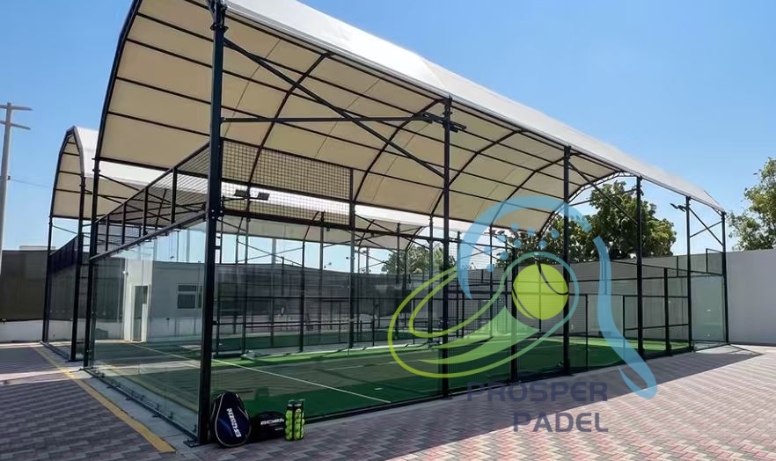
There is no single standard price for a covered padel court because the scope of construction varies considerably between projects.
For an initial international market reference, a published 2026 padel construction cost guide estimates:
Uncovered outdoor padel court: $25,000–$65,000.
Covered outdoor padel court: $60,000–$95,000.
Indoor court within an existing building: $45,000–$65,000, excluding the cost of the existing building.
Indoor court with a new building envelope: $100,000–$200,000 or more.
These indicative ranges represent different construction scopes and should not be interpreted as fixed worldwide prices.
Regional differences can be substantial.
For example, the Lawn Tennis Association (LTA) publishes the following UK construction benchmarks for new padel facilities:
| Number of Courts | Courts, Bases and Drainage | Additional Canopies and Foundations | Combined Budget |
|---|---|---|---|
| 1 Court | £71,000 | £75,000 | £146,000 |
| 2 Courts | £148,000 | £135,000 | £283,000 |
| 3 Courts | £210,000 | £180,000 | £390,000 |
| 4 Courts | £268,000 | £220,000 | £488,000 |
Source: LTA Padel Construction Guidance. Combined figures are calculated by adding the published court and canopy budgets. They are indicative UK benchmarks, not guaranteed 2026 quotations, and additional project expenses may apply.
The difference between these references demonstrates why buyers should never compare two prices without checking the construction scope.
A low-cost court equipment quotation, a complete covered court package, and a fully installed commercial facility are three different purchases.
The total covered padel court cost can be divided into several major components.
The padel court itself forms the foundation of the project budget.
A standard court package generally includes:
Steel enclosure structure and mesh fencing.
Tempered glass panels.
Artificial turf and infill materials.
Net and associated accessories.
Court doors and hardware.
Lighting equipment, depending on the selected package.
The type of court also influences the price.
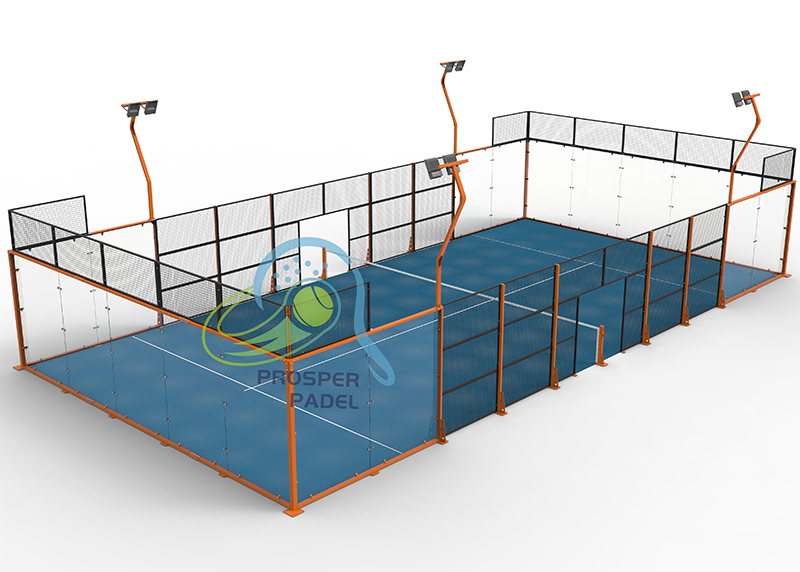
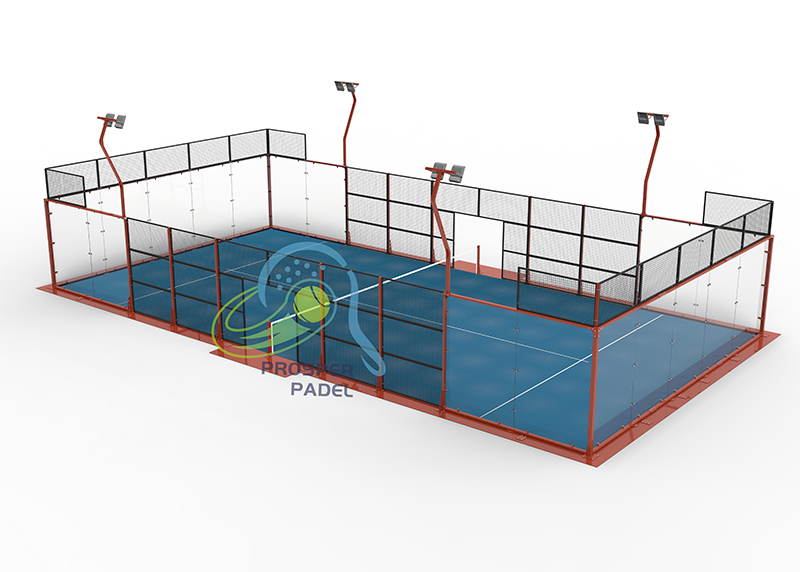
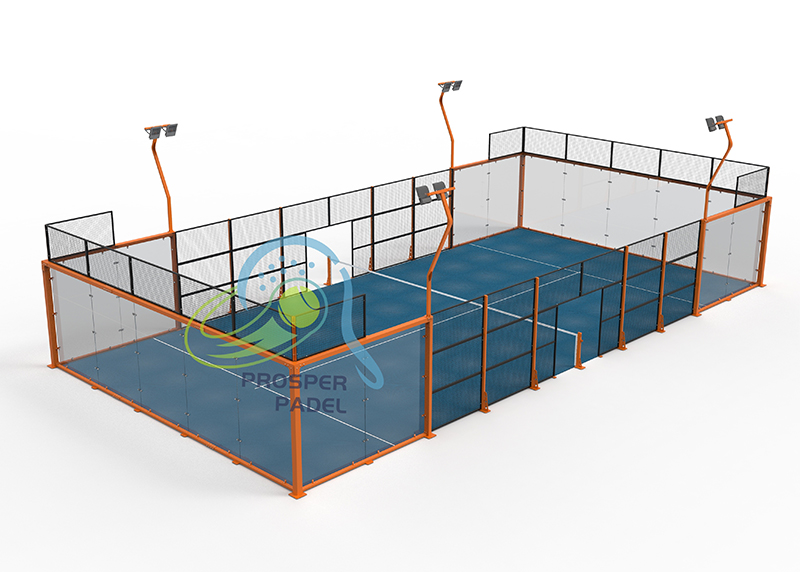
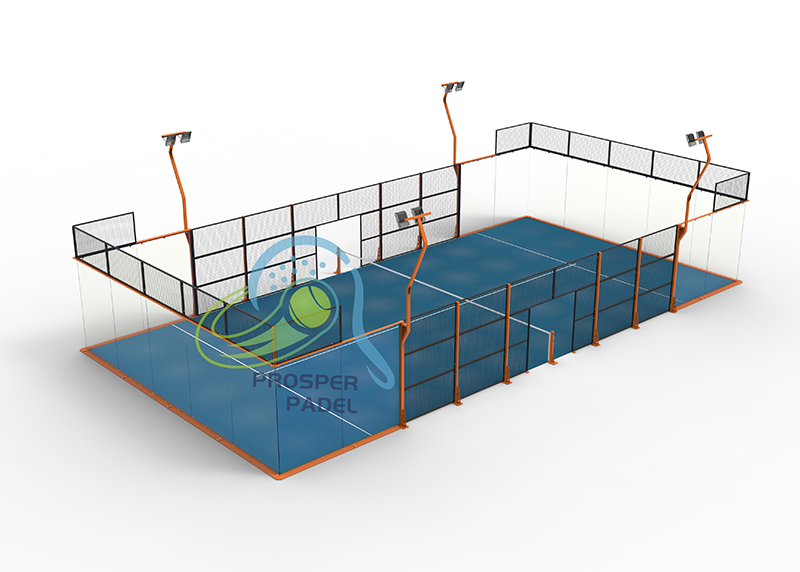
A conventional padel court uses a more traditional arrangement of structural posts and glass panels. A panoramic or super panoramic court typically provides wider viewing angles with fewer visual obstructions.
For commercial clubs and tournament venues, panoramic designs are often attractive because they improve spectator visibility and overall presentation.
However, larger glass panels, structural specifications, protective treatments, and customized finishes can increase the initial equipment cost.
Buyers should therefore choose the court configuration according to the venue's commercial objectives rather than selecting the cheapest available structure.
The roof is one of the most important additional expenses when converting an outdoor court into a covered facility.
A typical padel court roof requires its own supporting structure, covering material, anchoring system, and drainage arrangement.
The cost depends on several factors:
Roof size and span
A standard doubles padel court measures 20 meters long and 10 meters wide, but the roof generally needs a larger footprint to provide suitable weather protection.
Additional width and length may be necessary for overhangs, circulation areas, and protection against wind-driven rain.
Supporting structure
The selection of aluminum, steel, or another engineered structural system affects material quantities, transportation, installation methods, and foundation requirements.
Roof covering material
PVC membrane structures, rigid roofing panels, and fully enclosed building systems have different material, structural, and maintenance requirements.
Local weather conditions
Sites exposed to strong winds, heavy rainfall, or snow may require additional structural capacity, reinforcement, and drainage provisions.
For buyers considering a flexible alternative to conventional permanent buildings, customized sports tents and canopies can be evaluated for covered padel projects.
Juzhixin Sports offers customizable sports tent solutions with different structural configurations, including arched and A-frame designs. The appropriate option depends on court layout, weather exposure, and engineering requirements.
Foundation costs are frequently underestimated during the initial planning stage.
A covered padel court project may require two separate structural considerations:
The foundation and base supporting the padel court enclosure.
The foundations supporting the roof or canopy structure.
The groundworks budget can include excavation, leveling, concrete construction, reinforcement, drainage, and structural anchoring.
A site with an existing suitable concrete base may require less preparation than undeveloped land. However, an existing slab should not automatically be assumed capable of supporting a new padel court or roof.
A qualified local engineer should evaluate ground conditions and the proposed structural loads before construction.
For example, installing a canopy over an existing padel court may still require new foundations outside the playing enclosure.
This is why a roof retrofit quotation should account for foundation design rather than simply adding the price of roofing materials.
For international projects, transportation is another important part of the total investment.
Padel court equipment generally includes large glass panels, steel components, turf rolls, lighting accessories, and installation hardware.
Adding a roof increases the amount of material that must be transported.
Shipping costs depend on:
Destination country and port.
Packaging dimensions and container requirements.
Total shipment volume and weight.
Inland delivery distance.
Customs duties and applicable import taxes.
Buyers purchasing directly from overseas manufacturers should confirm the agreed Incoterms and shipping responsibilities.
For example, an EXW quotation is not directly comparable to a delivered or installed quotation because the responsibilities and included costs are different.
For multi-court projects, coordinating the shipment of court structures and canopy components may help simplify procurement and logistics.
Installation costs depend on the technical complexity of the selected solution.
A covered padel court normally involves several construction stages, including base preparation, roof support installation, court assembly, glass installation, turf installation, lighting, and final inspection.
Roof construction may also require lifting equipment, scaffolding, or specialized installation teams.
Labor costs can vary considerably between countries.
Before selecting a supplier, buyers should ask whether the quotation includes installation labor, machinery, travel expenses, and technical supervision.
It is also important to establish which activities will be completed by the product manufacturer and which must be arranged by local contractors.
The initial construction quotation may not represent the full project budget.
Depending on the venue, additional costs can include planning approval, structural calculations, site surveys, electrical connections, lighting controls, perimeter drainage, and access improvements.
Commercial projects may also require supporting facilities such as reception areas, seating, parking, walkways, and spectator areas.
These expenses should be considered during project planning rather than after equipment has been ordered.
Different roof configurations create different cost structures.
The most suitable solution depends on how the venue will be used and the level of weather protection required.
An open-sided canopy provides overhead protection while maintaining natural ventilation.
This configuration may be suitable for regions where rainfall and direct sunlight are the main concerns.
Compared with a fully enclosed sports building, it can avoid certain building-envelope expenses, although structural foundations, roof drainage, and wind resistance remain important.
For clubs seeking a balance between weather protection and construction cost, an appropriately engineered canopy is worth evaluating.
A partially enclosed structure offers additional protection from wind-driven rain and changing weather.
It may use a customized roof together with selected side coverings or rain screens.
The additional materials and structural requirements can increase the cost compared with an open-sided canopy.
However, this configuration may provide more reliable playing conditions in locations with frequent unfavorable weather.
A fully enclosed building provides a different level of environmental protection.
It may require wall systems, ventilation, insulation, fire-safety provisions, and mechanical equipment in addition to the padel courts.
Consequently, constructing an entirely new indoor facility generally involves a larger and more complex investment.
For clubs that do not require full indoor environmental control, a covered outdoor design may be a more practical starting point.
For more information about roof design considerations, see our guide to panoramic courts with roofs.
Two projects with the same number of courts can have substantially different budgets.
Several factors deserve particular attention during supplier evaluation.
Roof height and playing clearance
A roof must provide sufficient unobstructed height for padel play.
The minimum playing clearance and the recommended clearance for new facilities should be checked against applicable padel rules and competition requirements.
Increasing the roof height can affect structural design, material quantities, wind exposure, and overall cost.
Wind and snow loads
A canopy suitable for a relatively sheltered site may not be appropriate for a coastal location or a region with substantial snow accumulation.
Structural requirements must be confirmed for the specific installation site.
Number of courts
A single-court project may require its own foundations, transportation, and installation arrangements.
Larger developments may benefit from shared mobilization, coordinated construction, and an integrated roof system.
However, a large-span roof also introduces different structural demands.
Premium court finishes, customized steel colors, special lighting configurations, branded elements, and surrounding spectator facilities can affect the final price.
Customization should therefore be specified before suppliers prepare their commercial offers.
The most effective approach is not necessarily to choose the cheapest court or roof.
Instead, buyers should look for ways to reduce unnecessary construction expenses while maintaining safety and long-term performance.
Designing the padel court and canopy as one coordinated project can reduce the risk of structural conflicts and later modifications.
Column positions, roof clearance, drainage, lighting, and access should be reviewed before construction begins.
This is especially important for panoramic courts, where poorly positioned roof supports can obstruct spectator views.
When building several courts, it may be worth comparing separate canopies with one larger covering structure.
An integrated design can sometimes improve space utilization and construction coordination.
However, the most economical solution must be determined from the actual span, foundation requirements, structural loads, and available site dimensions.
A fully enclosed sports hall is not required for every padel project.
If the main objective is to reduce exposure to rainfall or direct sunlight, an open-sided canopy may satisfy the operational requirements without adding the complexity of a complete indoor building.
The design should be based on local climate and expected court usage.
Direct communication with a padel court manufacturer can help buyers identify suitable configurations before committing to equipment purchases.
For projects involving multiple courts and supporting facilities, working through a coordinated one-stop sports venue solution can also simplify design discussions and procurement planning.
Juzhixin Sports supports customized padel court configurations, including steel structure colors, turf colors, lighting pole designs, and related venue facilities.
This allows project owners to evaluate the court and its supporting structures in relation to their actual needs.
A reliable quotation requires more information than simply asking for the price of one court.
Before contacting a supplier, buyers should prepare the following project details:
Project location: Country, city, and installation environment.
Number of courts: Single court or multiple-court development.
Court type: Standard, panoramic, or super panoramic.
Site conditions: Available dimensions, ground surface, and existing foundations.
Roof requirements: Open-sided, partially enclosed, or other preferred configurations.
Local climate: Expected wind conditions, rainfall, snow, and other environmental factors.
Delivery requirements: Equipment supply only, delivery, technical support, or installation coordination.
The quotation should clearly distinguish between the padel court equipment, roof materials, shipping, installation, and any excluded local construction work.
Buyers should also request details about material specifications, structural requirements, project documentation, and after-sales support.
This provides a more reliable basis for comparing multiple suppliers.
The price depends on the canopy dimensions, supporting frame, roofing material, foundations, and local structural requirements.
Published market estimates vary widely because some quotes cover only roof equipment while others include foundations, drainage, and installation.
A roof-only quotation should therefore specify exactly what is included before it is compared with the price of a complete covered court.
A covered outdoor court can be less expensive than constructing a fully enclosed indoor sports building because it may not require complete walls, HVAC, insulation, and other building systems.
However, installing a court inside an existing suitable building may involve a different cost structure.
The comparison depends on whether a new building is required.
Yes, in some cases, an existing court can be upgraded with an independent canopy structure.
Before proceeding, the site should be assessed for foundation requirements, available space, structural loads, drainage, and required playing clearance.
Adding a roof should not be treated as a simple attachment to an existing court enclosure without suitable engineering assessment.
It can.
Multi-court projects may share certain design, logistics, mobilization, and construction expenses.
As the published UK construction benchmarks demonstrate, the average combined cost per court can fall as the number of courts increases.
However, actual savings depend on the roof design, site layout, and construction scope.
Depending on the supplier, an equipment quotation may exclude civil works, foundations, shipping, import duties, installation labor, equipment rental, electrical connections, and planning approval.
Buyers should request a written scope of supply and exclusion list before signing a contract.
The cost of a covered padel court in 2026 depends on considerably more than the price of the court enclosure.
Roof structure, foundations, drainage, transportation, installation, and local construction requirements can all have a major influence on the final investment.
For buyers planning new commercial facilities, the most practical approach is to define the court specifications and roof requirements together, compare quotations with equivalent scopes, and account for local construction costs before placing an order.
Tianjin Juzhixin Sports provides customizable padel court systems and sports venue solutions for international projects. From court configurations and structural colors to sports canopies and supporting facilities, we help buyers evaluate solutions based on their venue layout and project requirements.
Planning a covered padel court project in 2026? Contact Juzhixin Sports to discuss your court specifications, roof requirements, and customized equipment quotation.
Click To Get Your Exclusive Plan
Tianjin Juzhixin Sports Technology Co., Ltd is an innovative sports technology and import and export sales enterprise based in Tianjin and radiating its business worldwide. It is dedicated to empowering the development of the sports industry with technology
Contact Us
HOT Products

+86 189 2070 7687
Huamao Building, Binhai New Area, Tianjin
Copyright @ Tianjin Juzhixin Sports Technology Co., Ltd All Rights Reserved | Sitemap
| Powered by