Oct.20,2026
Share:
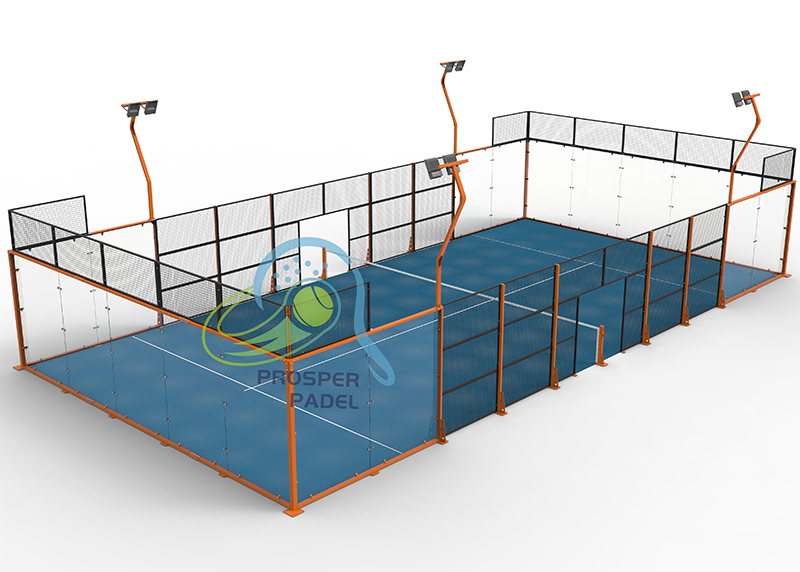
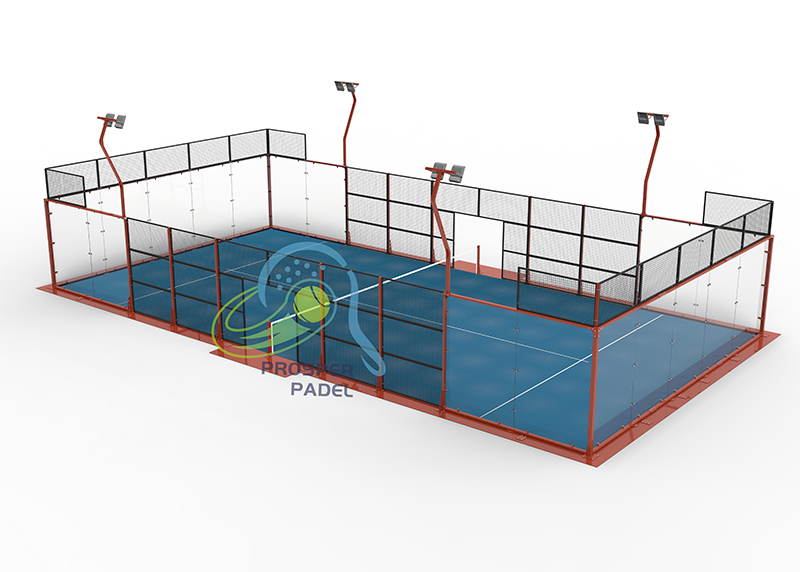
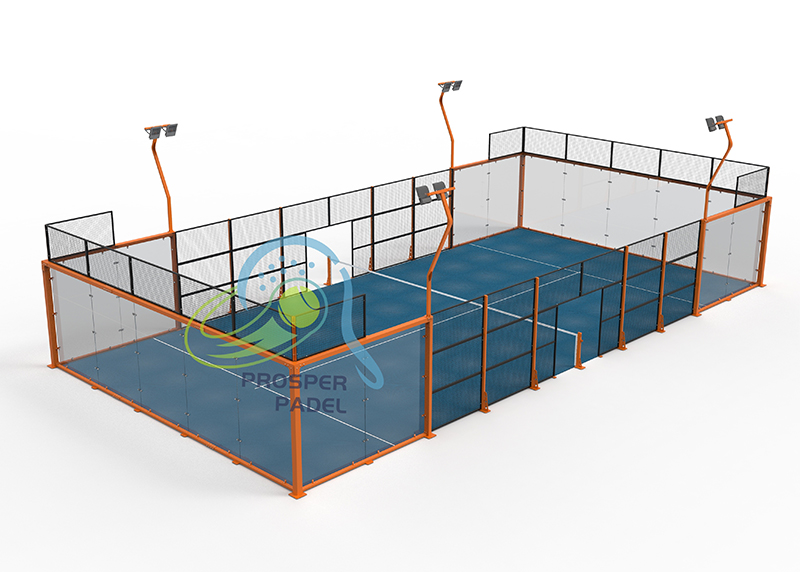
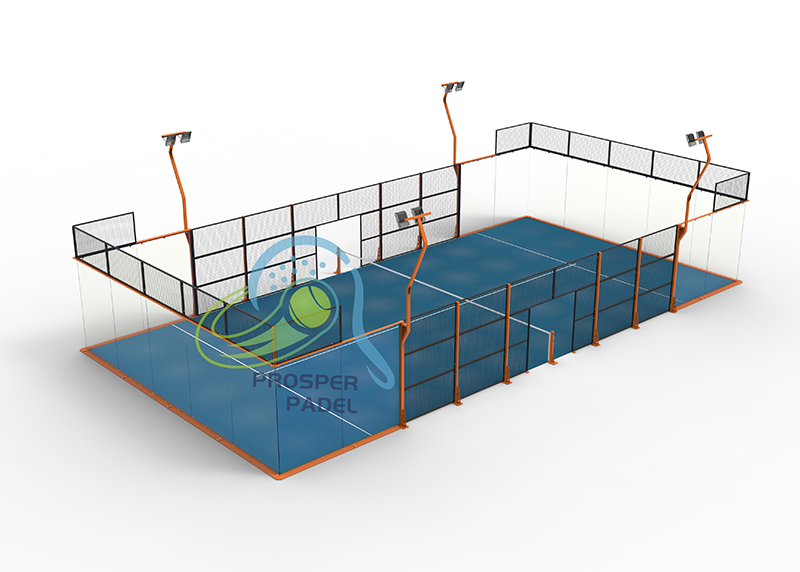
A panoramic padel court is a specialized padel court design that combines transparent glass walls with a reduced number of visually obstructive structural posts, creating clearer views of the playing area. Compared with traditional padel courts, panoramic structures emphasize visibility, streamlined steel framing, and a more open appearance, making them popular in commercial clubs, professional sports venues, and tournament facilities.
However, the performance of a panoramic padel court depends on more than its appearance. The supporting steel structure, tempered glass panels, fencing, artificial turf, lighting, and anchoring system must work together to provide stability, safety, and consistent playing conditions.
Modern panoramic padel court customization also allows venue developers to select different structural finishes, turf colors, lighting pole designs, and branding details. These choices help adapt a standardized playing environment to different architectural styles and commercial requirements.
This guide explores the main components of panoramic padel courts, available customization options, and the practical considerations involved in designing a complete padel facility.
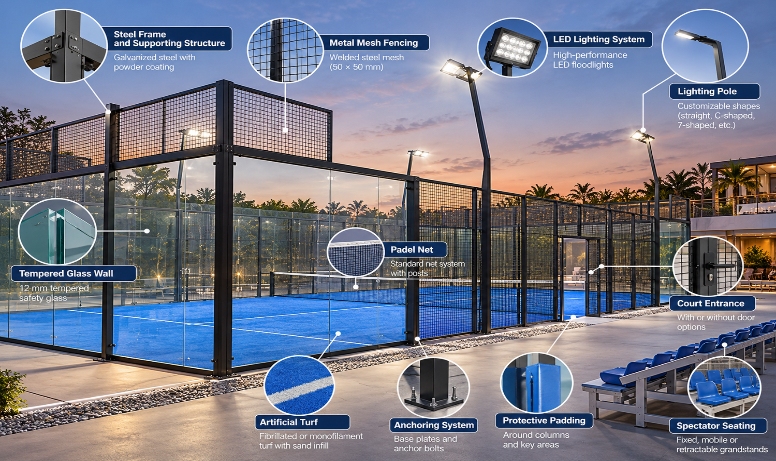
A panoramic padel court is a variation of the standard enclosed padel court that uses structural framing designed to reduce visual obstructions around the glass walls.
In traditional padel court structures, vertical steel posts are typically installed between glass panels, providing support and connecting the enclosure.
Panoramic designs reduce or reposition some of these posts, particularly around the glass end walls, while maintaining the required structural strength through engineered frames, beams, and connections.
The result is a more continuous viewing area for spectators, coaches, referees, and cameras.
The main characteristics of a panoramic padel court include:
Transparent tempered glass walls with fewer visual obstructions.
Engineered steel frames supporting the glass and fencing.
Clear viewing angles suitable for spectators and broadcasting.
Standardized playing dimensions and enclosure requirements.
Customizable turf, lighting, structural finishes, and accessories.
The term panoramic describes the structural and visual configuration rather than a different set of playing rules.
A complete panoramic padel court consists of several interconnected systems. Each component performs a specific function, and its quality affects the overall safety, durability, and playing experience.
The steel frame forms the structural foundation of a panoramic padel court enclosure.
Its primary role is to support the glass panels and metal fencing while transferring loads to the anchoring system and foundations.
Typical structural components include:
Main supporting columns.
Horizontal top and bottom beams.
Perimeter steel framing.
Reinforced corner connections.
Base plates and anchor bolts.
Brackets and fasteners connecting glass and fencing.
Unlike conventional court structures, panoramic designs often rely on longer supporting beams or reinforced connections to maintain stability where vertical posts have been removed.
Hot-dip galvanized steel is commonly used because it provides corrosion protection, particularly for outdoor installations.
Powder coating can provide an additional protective finish and allows the structure to match a venue's preferred color scheme.
However, galvanization and powder coating are not substitutes for proper structural design.
The dimensions and wall thicknesses of steel profiles must be selected according to structural calculations, local wind conditions, applicable construction standards, and the specific court configuration.
For example, exposed coastal facilities may require more demanding corrosion protection and structural design than sheltered indoor installations.
The most important consideration is ensuring that panoramic visibility does not compromise the enclosure's structural integrity.
Tempered glass is one of the defining elements of a panoramic padel court.
Unlike ordinary sports fencing, glass walls form part of the playing enclosure and directly influence how the ball rebounds during a match.
A panoramic glass system should provide:
Consistent and predictable ball rebound.
A smooth and uniform playing surface.
Sufficient strength and impact resistance.
Secure connections to the supporting structure.
Clear visibility for players and spectators.
Commercial panoramic courts commonly use 12 mm tempered safety glass, although the required thickness and glass specification depend on the structural design and applicable standards.
Glass thickness alone does not determine safety. Panel dimensions, edge quality, support conditions, mounting hardware, and installation tolerances are equally important.
A suitable glass fixing system may incorporate protective gaskets or other approved contact materials to prevent direct metal-to-glass contact and accommodate appropriate tolerances.
In panoramic configurations, the reduction of vertical posts makes the connection between adjacent glass panels particularly important.
The installation must maintain uniform wall alignment without creating dangerous gaps, protrusions, or irregular rebound surfaces.
For tournament-oriented projects, glass specifications should also be checked against the relevant FIP homologation requirements.
Although panoramic courts emphasize transparent glass walls, metal mesh fencing remains essential to the enclosure.
The mesh prevents balls from leaving the playing area and completes the upper and side sections of the court.
A typical system uses welded steel mesh attached to framed sections or the main court structure.
Important specifications include:
Mesh opening dimensions.
Wire diameter.
Surface coating.
Frame connection strength.
Weld quality and finishing.
Protection against sharp or exposed edges.
Under FIP rules, square electro-welded mesh must meet specified opening and wire requirements. A 50 × 50 mm square mesh with appropriately sized wire is a common commercial configuration, subject to confirmation against the applicable rules.
The mesh must provide a suitable ball response while maintaining a safe playing environment.
For outdoor courts, corrosion resistance is especially important because exposed fencing can experience continuous contact with moisture, sunlight, and changing temperatures.
Artificial turf is a critical performance component because it affects traction, movement, ball bounce, and playing comfort.
Most commercial panoramic padel courts use synthetic turf systems specifically designed for padel.
Common options include fibrillated and monofilament artificial grass.
Fibrillated turf uses fibers that split into finer strands during use. It has traditionally been widely used for padel and works with a suitable sand-infill system.
Monofilament turf uses individual synthetic fibers and is often selected for its surface characteristics, appearance, and durability.
Both systems can provide appropriate playing conditions when the complete installation meets relevant performance requirements.
Turf selection should consider:
Fiber construction and pile height.
Surface traction and player movement.
Ball rebound consistency.
Wear resistance.
Sand-infill quantity and distribution.
Drainage and maintenance requirements.
Blue and green are common turf colors, while terracotta and other approved shades may be selected for particular venue designs.
Color customization should maintain adequate contrast with court lines, balls, and surrounding structures.
The underlying base is equally important. Even premium artificial turf cannot compensate for an uneven foundation or inadequate drainage.
Proper lighting is essential for panoramic padel courts used during evening hours or in enclosed sports facilities.
A typical lighting system uses LED floodlights installed on dedicated poles or integrated into suitable structural arrangements.
The primary objective is to provide even illumination across the playing area without creating excessive glare.
Lighting performance depends on fixture positioning, mounting height, beam angle, and the number of luminaires.
Different venues may require different lighting performance:
Recreational clubs prioritize comfortable visibility.
Training centers need consistent playing conditions.
Competition venues may require higher illuminance and uniformity.
Broadcast venues need additional attention to vertical illumination and camera requirements.
Lighting poles can also influence the visual appearance of the court.
Common customizable designs include straight, C-shaped, 7-shaped, and S-shaped lamp posts.
However, lamp-post selection should begin with the lighting design and structural requirements rather than appearance alone.
For indoor or covered courts, the position of fixtures and roof components must also be coordinated to avoid interfering with high shots.
Smaller structural elements play an important role in daily safety and usability.
Court entrances must provide suitable access for players while maintaining the enclosure's stability.
Depending on the intended use and applicable regulations, entrances may be configured with or without doors.
Protective padding may be installed around exposed structural components, entrance areas, and other locations where player contact is possible.
Padel court accessories also include the central playing net, net posts, fixing hardware, and related protective components.
For professional or tournament facilities, the entrance arrangement and surrounding safety areas should be designed with out-of-court play requirements in mind.
These details should be included in the original structural drawings rather than treated as optional adjustments after installation.
Panoramic court designs are often classified into several structural categories.
However, terminology varies between manufacturers, and there is no universal structural definition for every commercial product label.
The following table summarizes common distinctions.
| Court Type | Structural Characteristics | Main Advantage | Typical Application |
|---|---|---|---|
| Standard Padel Court | More vertical posts separating enclosure sections | Straightforward conventional construction | Recreational and community facilities |
| Panoramic Padel Court | Reduced posts around key glass viewing areas | Improved visibility | Commercial clubs and training centers |
| Full Panoramic Padel Court | More continuous glass-wall framing with fewer obstructive supports | Wider viewing angles | Premium clubs and competition venues |
| Super Panoramic Padel Court | Further visual optimization using engineered beams and connections | Enhanced spectator and camera visibility | High-profile events and professional venues |
A more panoramic appearance does not automatically mean that a structure is stronger or safer.
Removing posts changes how loads are transferred through the enclosure, so beam profiles, connections, and anchoring may need to be reinforced.
The most appropriate design depends on the intended application, environmental loads, structural documentation, and installation conditions.
Although regulation playing dimensions and essential safety requirements must be maintained, many elements of a panoramic padel court can be customized.
These options fall into several main categories.
Steel structure color is one of the most visible customization options.
Black is frequently used for its clean, modern appearance, while white, green, blue, orange, and other colors can be chosen to match a sports club or architectural environment.
Powder coating provides a wide range of finish options and can be specified according to recognized color systems such as RAL.
For outdoor installations, the coating system should be suitable for local exposure conditions.
The final choice should balance appearance, corrosion protection, maintenance, and compatibility with other venue elements.
Turf customization offers another way to create a distinctive playing environment.
Blue courts are common in modern commercial facilities, while green is often selected for a more traditional sports aesthetic.
Different shades can be considered to coordinate with surrounding buildings, club branding, and event presentation.
However, color should not be selected independently of the turf's technical properties.
Fiber construction, surface friction, sand infill, drainage, and ball rebound remain the primary performance considerations.
For multi-court facilities, consistent turf specifications can also simplify maintenance and deliver a more uniform playing experience.
Lighting poles can be customized in both shape and color.
Straight posts provide a simple structural appearance, while C-shaped, 7-shaped, or curved poles can create a more distinctive architectural effect.
These options may be useful for clubs that want lighting fixtures to complement the court's panoramic appearance.
Pole height, fixture positioning, and support strength must be reviewed as part of the lighting and structural design.
The preferred appearance should never compromise illuminance, player visibility, or required clearance.
Customization is not limited to decorative elements.
Some projects require upgraded structural specifications because of their installation environment.
For example, courts in high-wind regions may need additional reinforcement, different beam profiles, or modified anchoring arrangements.
Coastal locations may require enhanced corrosion protection.
Protective padding and covers can also be adapted to specific structural configurations.
The selected materials must remain compatible with player safety requirements and the intended maintenance program.
For commercial sports facilities, visual identity is often an important part of the overall venue design.
Custom branding may be incorporated into suitable non-playing components, such as:
Structural frame covers.
Protective padding.
Net bands.
Exterior panels.
Selected accessories.
Logos and graphics should not obstruct visibility, create unsafe surfaces, or interfere with ball rebound.
Branding applied to playing walls must also comply with applicable regulations.
The best approach is to integrate these elements during the design stage so that appearance, durability, and safety remain consistent.
Not every available customization feature is necessary for every project.
A practical approach is to prioritize modifications according to their purpose.
For commercial padel clubs, structural durability, consistent turf performance, and efficient lighting are generally the first priorities. Colors and branding can then be selected to create a recognizable venue identity.
For premium hotels and resorts, architectural appearance may carry greater importance. Panoramic framing, coordinated finishes, and carefully designed lighting can help the courts fit into a larger leisure environment.
For professional competition venues, spectator visibility, camera positions, playing clearance, uniform lighting, and safe access routes should receive particular attention.
For outdoor facilities in challenging climates, the main priorities may include wind-load design, corrosion resistance, drainage, and suitable structural foundations.
The most effective customized panoramic padel court is not necessarily the one with the most modifications. It is the one whose specifications address the actual site conditions and intended use.
A panoramic padel court should be designed as part of a complete sports facility rather than as an isolated enclosure.
This becomes especially important for projects involving multiple courts, spectator areas, or additional sports facilities.
A regulation doubles court occupies 200 square meters of playing area, but the overall installation footprint is larger.
Additional space is required for the enclosure, access paths, maintenance, and supporting facilities.
Multi-court layouts should also consider the distance between courts, player circulation, emergency access, and potential future expansion.
Where spectators will be present, circulation routes should prevent unnecessary interaction between players entering or leaving courts and people watching matches.
Outdoor panoramic courts require particular attention to drainage, corrosion protection, foundations, and local environmental conditions.
Indoor facilities must provide sufficient overhead playing clearance and suitable lighting, ventilation, and access.
FIP regulations specify a minimum unobstructed height of 6 meters throughout the court and recommend 8 meters for new facilities.
For projects considering a roof or canopy, the supporting columns, roof beams, and lighting fixtures should be coordinated with the court enclosure before construction.
Correct installation is essential to structural performance.
Steel alignment, base-plate anchoring, glass positioning, mesh connections, and turf preparation all require suitable quality control.
After installation, regular inspections should cover:
Structural connections and corrosion.
Glass integrity and mounting hardware.
Mesh condition and exposed edges.
Turf wear and infill distribution.
Lighting equipment and electrical safety.
Entrance padding and other protective components.
Planning maintenance access from the beginning can make long-term facility management more efficient.
The main difference is the arrangement of the enclosure's supporting posts and beams.
Panoramic designs reduce visual obstructions around glass-wall sections, using engineered structural connections to maintain stability while improving visibility.
Many commercial panoramic courts use 12 mm tempered safety glass.
However, thickness is only one specification. Panel dimensions, glass quality, fixing methods, structural design, and applicable standards must also be considered.
The standard regulation doubles playing area measures 20 × 10 meters internally.
The surrounding layout, supporting structural configurations, colors, and accessories can be customized, but the internal court dimensions and mandatory enclosure requirements must be preserved for regulation play.
Yes. Panoramic courts can be installed outdoors when the structure, foundations, anchoring, and materials are designed for local environmental conditions.
Wind exposure, corrosion resistance, drainage, and periodic inspection are particularly important.
Common customization options include steel structure colors, artificial turf colors, lighting pole shapes, protective padding, logos, and selected structural specifications.
The available options depend on the court configuration and supplier.
A well-designed panoramic padel court combines structural stability, transparent glass walls, durable fencing, professional artificial turf, and carefully positioned lighting.
Customization provides additional flexibility, allowing venue developers to adapt the appearance and configuration of the court without compromising essential playing and safety requirements.
However, a successful padel project also depends on how the court connects with its surrounding facilities.
For commercial clubs and competition venues, spectator seating is an important part of the overall sports facility design. Properly positioned seating can take advantage of the panoramic court's unobstructed viewing angles while improving comfort and circulation during matches.
For venues that need flexible spectator capacity, mobile and retractable grandstands can provide additional seating during tournaments while allowing the surrounding space to be used differently during normal club operations.
Tianjin Juzhixin Sports incorporates these considerations into its one-stop sports venue solution, which connects customizable padel court systems with supporting facilities such as fixed, mobile, and retractable grandstand seating.
The available seating options include customizable dimensions, tier arrangements, seat colors, structural finishes, and selected manual or electric retractable configurations.
By considering court structure, customization, spectator visibility, and seating arrangements together, venue developers can create a more coordinated and practical environment for training, recreational play, and organized competitions.
Click To Get Your Exclusive Plan
Tianjin Juzhixin Sports Technology Co., Ltd is an innovative sports technology and import and export sales enterprise based in Tianjin and radiating its business worldwide. It is dedicated to empowering the development of the sports industry with technology
Contact Us
HOT Products

+86 189 2070 7687
Huamao Building, Binhai New Area, Tianjin
Copyright @ Tianjin Juzhixin Sports Technology Co., Ltd All Rights Reserved | Sitemap
| Powered by