Aug.19,2026
Share:
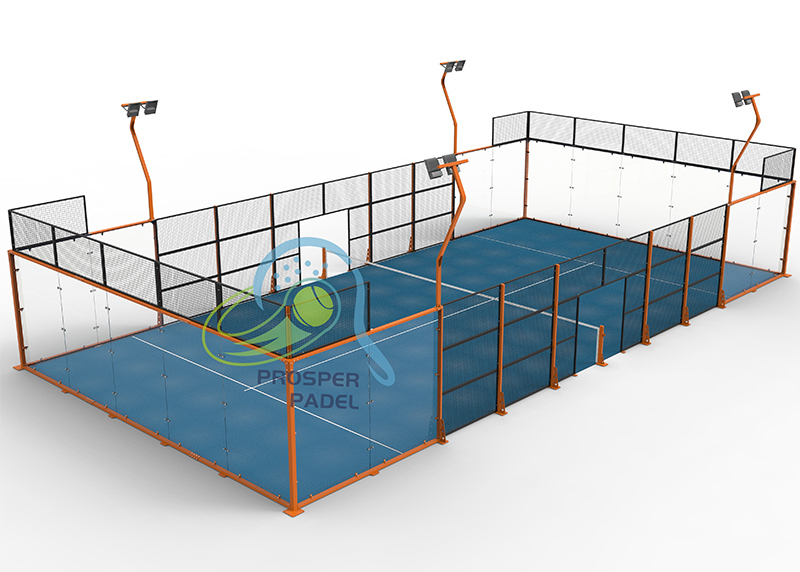
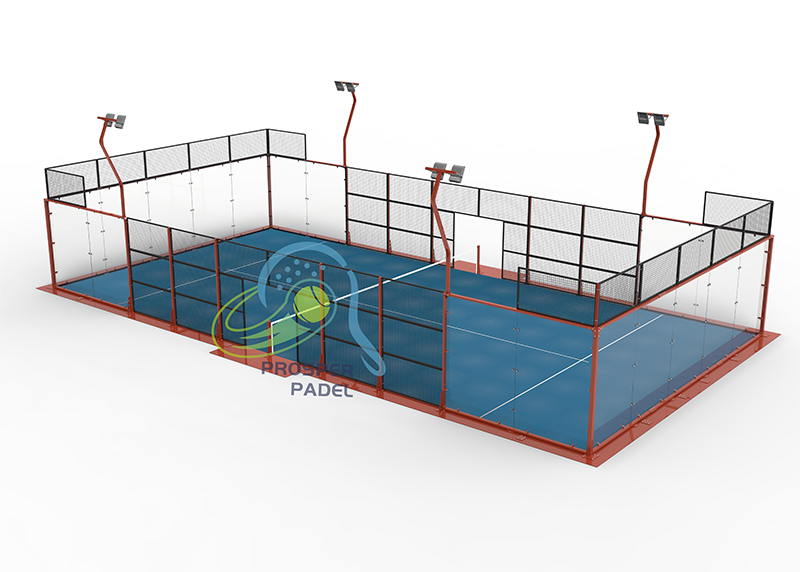
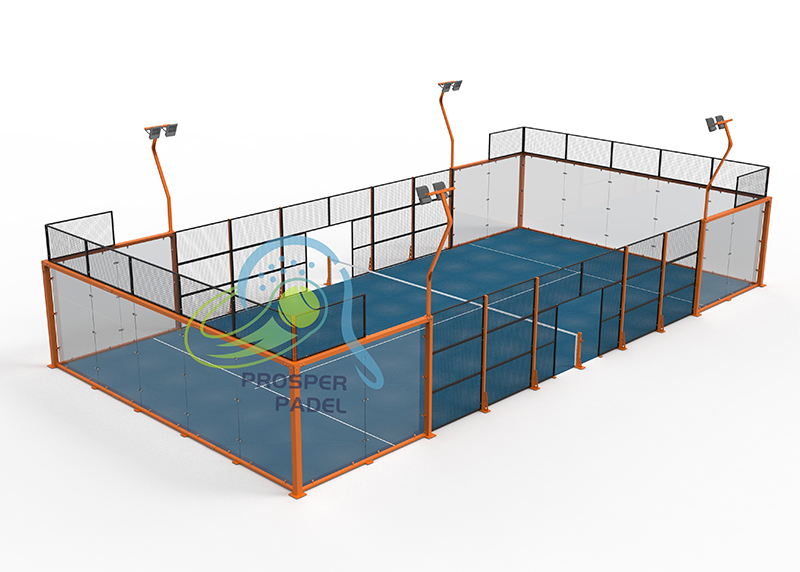
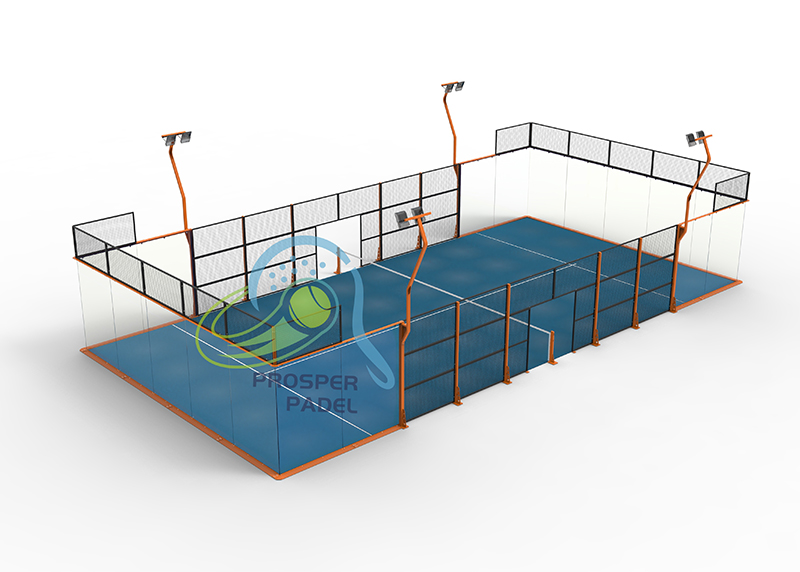
The padel court installation process normally follows a clear sequence: inspect and mark the prepared foundation, position the structural frame, install mesh fencing and tempered glass, complete lighting and electrical work, lay the artificial turf, fit the net and accessories, and then perform a final alignment and safety inspection.
The important point is that installation should not begin simply because the court components have arrived.
The concrete base, drainage, anchor positions, court dimensions, component quantities, and installation drawings should all be checked first. A small dimensional error at foundation level can become a much larger problem when installers begin fitting steel columns and large glass panels.
For buyers planning a new project, our broader padel court construction guide covers site preparation and foundation work. This guide starts where that stage ends: the actual on-site padel court installation.
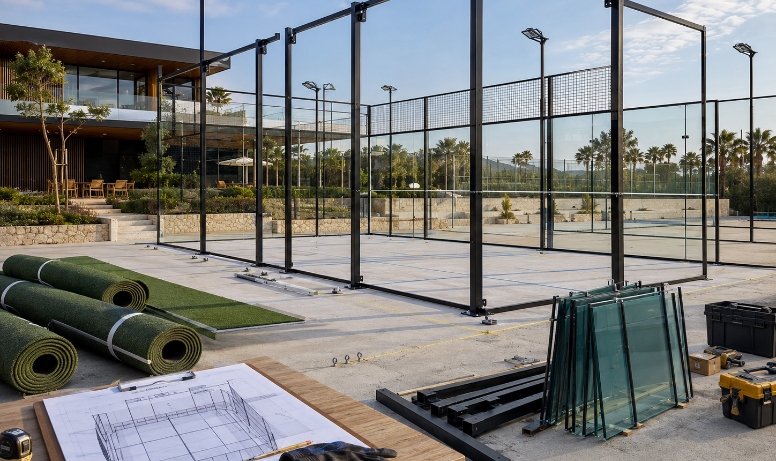
A typical installation can be organized into the following stages:
| Installation Stage | Main Work |
|---|---|
| 1. Pre-installation inspection | Check foundation, drainage, dimensions and materials |
| 2. Setting out | Mark court centerlines, corners and fixing positions |
| 3. Structural frame | Install columns, beams and structural supports |
| 4. Mesh fencing | Fit enclosure panels and verify alignment |
| 5. Tempered glass | Position, level and secure glass panels |
| 6. Lighting | Install poles, fixtures, wiring and controls |
| 7. Artificial turf | Lay, join, trim and finish the playing surface |
| 8. Net and accessories | Install posts, net, doors and protective elements |
| 9. Final inspection | Check structure, surface, lighting and playing dimensions |
The exact sequence can vary slightly according to the court design. A panoramic court, traditional framed court, indoor installation, or modular mobile padel court will not necessarily use identical fixing methods.
However, the basic principle remains the same: install from the permanent structural elements toward the more easily damaged finishing components.
Before unpacking the main court structure, installers should inspect the completed base.
This is one of the most important stages because the steel frame, glass walls, turf, and net all depend on the geometry of the foundation.
The inspection should confirm:
The International Padel Federation requires the playing surface to remain extremely even. Current FIP rules state that differences in internal surface levels should be less than 3 mm when measured over 3 meters. For surfaces without drainage, the maximum transverse evacuation slope is 1% from the center toward the outer edges.
This means installers should not use the steel structure to compensate for a poorly constructed base.
If the slab is outside tolerance, correcting it before assembly is normally much easier than attempting to realign glass and fencing later.
Outdoor projects also need particular attention to drainage. Water should leave the playing area effectively without creating low points where moisture can accumulate below or around the artificial turf.
Once the base has passed inspection, the next stage is setting out.
Installers transfer the approved drawings onto the foundation and mark:
A regulation doubles padel court has internal dimensions of 20 meters long by 10 meters wide, and the enclosure dimensions are measured from the inside of the court.
This distinction is important during installation.
Installers should work from internal finished dimensions rather than simply measuring the outside edge of steel components.
Before drilling or fixing anchors, diagonals should also be checked. Equal diagonal measurements help confirm that the rectangular layout is square.
Taking extra time here prevents a common problem: reaching the final side of the structure and discovering that the panels no longer align correctly.
The structural frame normally comes next.
Depending on the court design, this stage may involve:
Installers should not fully lock every connection immediately.
The frame is usually assembled progressively, checked for level, plumb, and square, and then tightened according to the installation specification.
This is particularly important for panoramic padel courts.
Because panoramic configurations reduce structural interruption around the glass areas, accurate alignment of the remaining steel structure becomes critical for correct glass installation.
Corrosion protection should also be inspected during assembly. Scratches or coating damage caused during transport or erection should be addressed according to the supplied maintenance or repair procedure before the project is completed.
With the main frame correctly positioned, installers can begin assembling the metal mesh sections.
The fencing is not simply a perimeter barrier. It forms part of the playable enclosure, meaning alignment can influence ball behavior and player safety.
Current FIP rules require the enclosure to form flat, vertical surfaces and specify that joins and fencing must not present sharp or pointed edges. The court ends reach a total height of 4 meters under the defined enclosure configuration.
During installation, technicians should check:
Panels should not be distorted simply to make them fit.
If a mesh section requires excessive force to align with adjacent columns, the structural frame should be checked again before proceeding.
Glass installation is one of the stages that requires the most care.
Padel court glass panels are large, heavy, and installed close to steel structural elements. Proper lifting equipment and handling procedures should therefore be planned before installation begins.
Each panel is positioned according to the installation drawing, supported correctly, aligned with neighboring panels, and secured using the specified fittings.
Installers should pay attention to:
The FIP requires glass courts to comply with applicable tempered/plate-glass requirements under its court homologation rules.
More importantly from an installation perspective, the glass needs to create a smooth, consistent playing enclosure.
A structurally secure panel that is poorly aligned can still create an undesirable transition where the ball moves from glass to another part of the enclosure.
Glass should therefore be inspected not only individually but also as a complete wall.
Lighting poles and fixtures are normally fitted once the main structure is stable.
Depending on the court design, the lamp posts may be integrated into the structural system or positioned independently outside the enclosure.
The process generally includes:
Lighting position matters because glare can directly affect play.
FIP rules state that artificial lighting should be uniform and should not create visual difficulty for players, officials, or spectators. Light poles are to be positioned outside the court, and the rules define minimum mounting considerations for the projectors.
For commercial clubs, installers should test the system after dark or under realistic operating conditions whenever practical.
A fixture can be electrically functional but still require angle adjustment to achieve a balanced playing environment.
Artificial turf is normally installed after the heavy structural and glass work is largely complete.
That order helps prevent the finished playing surface from being damaged by lifts, glass handling equipment, metal work, or repeated construction traffic.
Before laying the turf, the base should be:
clean → dry → level → free of debris
Turf rolls are then positioned according to the installation plan.
The installer aligns the pile direction, cuts the material to fit the enclosure, joins adjacent sections, and carefully finishes the perimeter.
Where the turf system requires infill, silica sand is distributed according to the turf manufacturer's specification and brushed into the fibers.
Several details matter here:
Joints should remain flat and secure. Raised or opening seams can affect player movement and ball behavior.
Turf should fit neatly around structures, net posts, and access points without loose edges.
The finished court should not contain obvious ridges, wrinkles, or depressions.
FIP permits artificial grass, synthetic material, or cement surfaces as long as the surface produces regular ball rebound and meets the relevant court requirements.
For this reason, turf installation is not just decorative finishing. It is part of establishing the final playing performance of the court.
Once the playing surface is finished, installers can complete the smaller court components.
These typically include:
The net requires particular attention.
According to current FIP rules, a regulation padel net is 10 meters long, 0.88 meters high at the center, and rises to 0.92 meters at the ends. The tensioning mechanism must also be designed so that it does not unexpectedly loosen or present a risk to players.
Installers should therefore verify both height and tension rather than simply attaching the net between the two posts.
Door handles and other protruding components also need inspection so that no unnecessary hard or sharp element projects into the playing space.
A padel court should not be considered finished as soon as the last bolt has been tightened.
The entire system should be inspected as one completed installation.
A final handover check should cover four areas.
Verify:
Inspect:
Test:
Confirm that there are no:
For a commercial club, it is useful to document this inspection rather than relying only on visual acceptance.
Photos, installation records, electrical testing information, component documentation, and maintenance instructions can all become part of the final project file.
The quality of installation depends on communication between the manufacturer, local contractor, and installation team long before the first column is erected.
A supplier should be able to provide accurate drawings, component identification, foundation requirements, assembly information, and technical support.
For example, JUZHIXIN SPORTS structures its one-stop project process around design communication, quotation and design analysis, production confirmation, quality inspection, packaging and delivery, followed by after-sales support. Its padel systems can also be customized in areas such as structural colors, turf colors, lighting-pole designs, and branding.
This coordination becomes especially useful for overseas installations.
Civil work may be performed by a local contractor while the court components are manufactured elsewhere. In that situation, the foundation drawing and the manufactured structure must match precisely.
JUZHIXIN also offers a modular mobile padel court whose standardized columns, crossbeams, glass panels, fencing, and turf are designed around bolted assembly, allowing the system to be dismantled and reassembled when required.
That installation approach is different from a permanent court with more extensive foundation work, which is why installation planning should always begin with the specific court system being purchased.
Most installation problems are not caused by one dramatic mistake. They develop from small errors earlier in the sequence.
Common examples include:
Installing on an unverified foundation.
An uneven or incorrectly dimensioned base creates alignment problems throughout the project.
Drilling anchors before checking diagonals.
Once structural positions are fixed, correcting a court that is out of square becomes much more difficult.
Fully tightening the frame too early.
Some adjustment is often necessary while the complete structure is being aligned.
Poor glass handling.
Tempered glass is strong in normal service but its edges remain vulnerable during transportation and installation.
Laying turf before heavy installation work is finished.
Construction equipment and glass installation can damage or contaminate the completed surface.
Skipping final testing.
A court can look complete while still having incorrect net height, loose fixings, lighting glare, or uneven turf.
Good installation is therefore largely about sequence and inspection.
The installation phase should be separated from the entire construction schedule.
Site preparation, concrete work, curing, drainage, permits, shipping, and electrical preparation may take much longer than assembling the actual court.
Once a correctly prepared foundation and all court components are available, the structural court installation itself can move relatively quickly with an experienced crew. Modular systems can further reduce assembly complexity because standardized components are designed for efficient on-site connection.
However, there is no useful universal installation time.
The schedule depends on court type, number of courts, crew size, lifting equipment, site access, glass handling conditions, lighting work, turf system, and local weather.
For buyers, a more useful question is:
What must be completed before the installation crew arrives?
If the slab, drainage, power supply, access route, and component inventory are ready, the installation stage is much less likely to suffer unnecessary delays.
A typical sequence is foundation inspection, setting out, steel-frame installation, fencing, tempered glass, lighting, artificial turf, net and accessory installation, followed by final testing. The exact sequence may change slightly according to the court design.
Potentially, yes, but the slab must first be checked for dimensions, level, structural suitability, drainage, and anchor requirements. An existing slab should not automatically be assumed suitable simply because it is large enough.
In most projects, turf is installed after the heavy structural, fencing, and glass work. This helps protect the finished playing surface from construction traffic and glass-handling equipment.
During setting out, installers check dimensions and compare diagonal measurements. This should be done before the main anchor positions are permanently fixed.
Yes. Structural fixings, glass, fencing, turf, net, lighting, access points, and potential safety hazards should all be checked before the court is put into normal use.
The padel court installation process step by step is straightforward in principle, but successful installation depends on much more than assembling steel, glass, and turf in the correct order.
The real sequence is:
verify → measure → assemble → align → finish → test.
A foundation should be accepted before the structure is installed. The frame should be aligned before glass is fitted. Heavy work should be completed before the turf is finished. And the entire court should be inspected before players enter it.
For sports clubs, resorts, training centers, and commercial padel facilities, following this sequence helps reduce rework and makes coordination between the court manufacturer, local construction team, and installer considerably easier.
A well-installed padel court should not only look correct on opening day. Its structure, enclosure, surface, lighting, and accessories should work together as one complete playing system.
Click To Get Your Exclusive Plan
Tianjin Juzhixin Sports Technology Co., Ltd is an innovative sports technology and import and export sales enterprise based in Tianjin and radiating its business worldwide. It is dedicated to empowering the development of the sports industry with technology
Contact Us
HOT Products

+86 189 2070 7687
Huamao Building, Binhai New Area, Tianjin
Copyright @ Tianjin Juzhixin Sports Technology Co., Ltd All Rights Reserved | Sitemap
| Powered by