Sep.09,2026
Share:
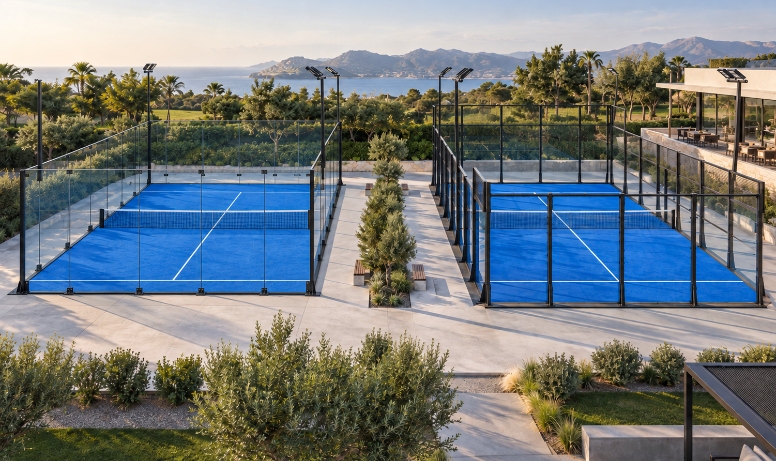
Choosing between a standard court and a full panoramic padel court is not simply a question of appearance. Both can use the same regulation playing dimensions, glass enclosure, artificial turf and lighting system. The main difference is how the structural frame is designed around the glass walls and how much of the spectator sightline is interrupted by steel posts.
For clubs, sports centers, hotels, developers and padel investors, that structural difference can affect visibility, engineering requirements, installation complexity, project cost and the overall positioning of the venue.
So, what is the practical difference between a panoramic padel court and a standard padel court, and which one makes more sense for your project?
| Factor | Standard Padel Court | Panoramic Padel Court |
|---|---|---|
| Playing dimensions | Typically 20 × 10 m for doubles | Typically 20 × 10 m for doubles |
| Structural design | More visible vertical framing around the enclosure | Reduced or eliminated posts in key glass viewing areas |
| Spectator visibility | More frame interruption | Wider, cleaner sightlines |
| Visual appearance | Functional and conventional | Open, modern and premium |
| Structural engineering | Conventional framed structure | Loads may be transferred through larger beams or reinforced framing |
| Installation | Generally straightforward | Often requires more precise alignment |
| Outdoor suitability | Depends on engineering and local wind conditions | Depends heavily on structural design, anchoring and wind calculations |
| Cost | Usually more economical | Often carries a higher structural cost |
| Typical applications | Training centers, schools, community clubs, budget-focused projects | Commercial clubs, premium venues, tournaments, resorts and showcase courts |
The important point is that “panoramic” describes the structural and visual configuration of the court rather than a different version of padel itself.
A panoramic padel court is not larger than a standard padel court simply because it has a more open appearance.
Under the International Padel Federation rules, a regulation doubles court measures 20 meters long by 10 meters wide and must be completely enclosed. The rules also define the required wall and fencing arrangements around the playing area.
This means that a properly designed standard court and panoramic court can both provide the same regulation playing area.
The difference begins outside the playing lines.
A standard court normally relies on a more conventional steel framing arrangement around the glass and mesh sections. A panoramic design reduces structural elements that would otherwise interrupt the view through the glass.
For buyers, this distinction matters because the question is not:
“Which court gives players more space?”
It is:
“How is the enclosure supported, and what effect does that structure have on visibility, engineering and cost?”
Traditional or standard padel courts usually have clearly visible steel posts around the perimeter and near the glass sections. These posts form part of the supporting structure and help transfer loads through the court frame.
Panoramic courts are designed differently.
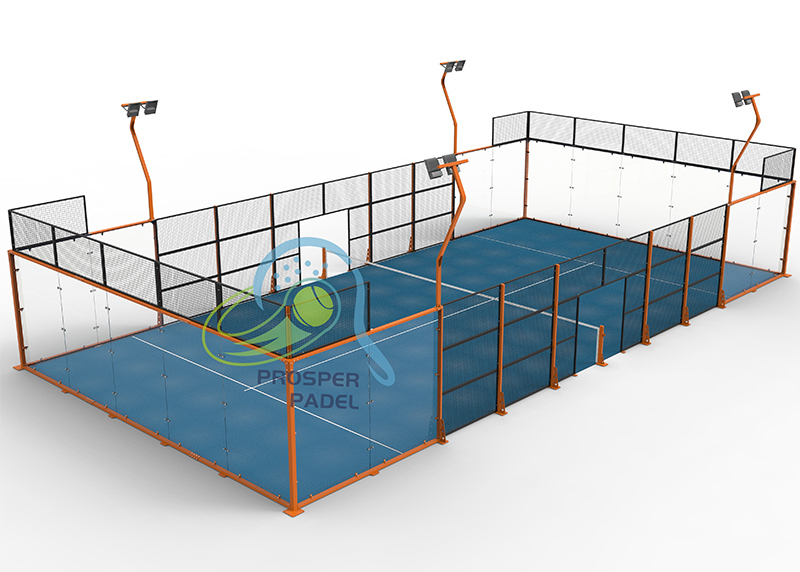
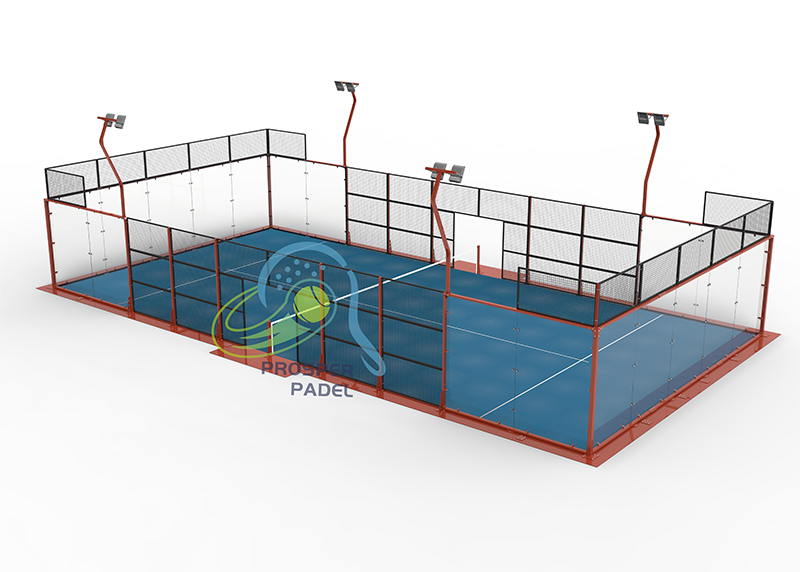
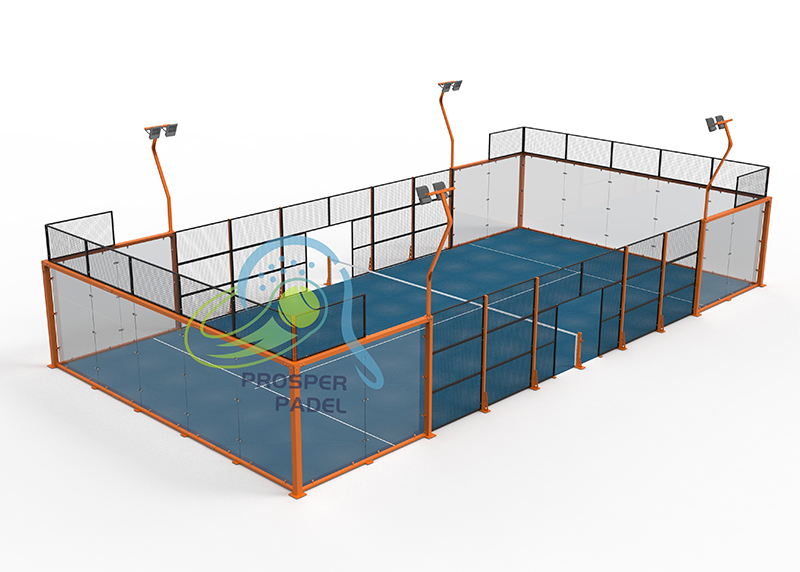
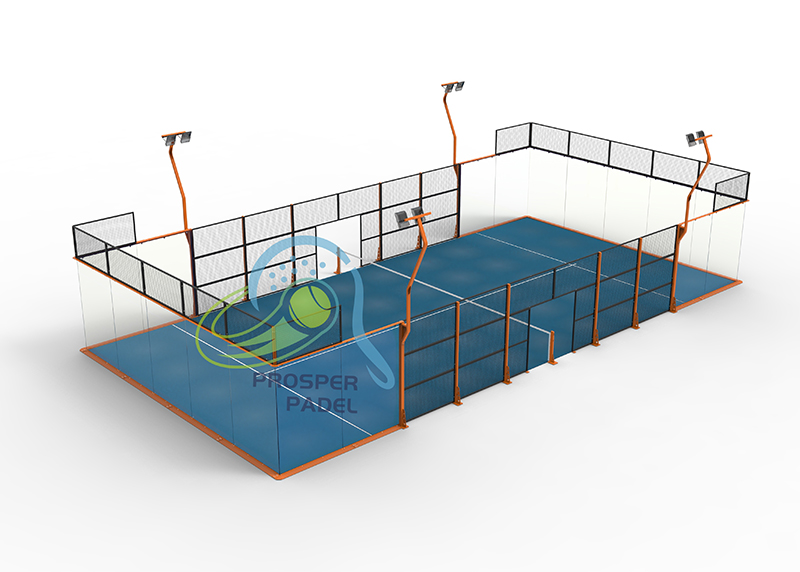
Depending on the model, manufacturers may reduce the number of posts around the glass or remove corner posts from important spectator viewing areas. A full panoramic design can create a nearly uninterrupted transparent enclosure.
For example, Juzhixin's Full Panoramic JZX-10 uses a corner-pillar-free configuration and continuous beam structure. Its current specification includes 100 × 50 × 3 mm hot-dip galvanized steel beams and columns together with 12 mm tempered glass.
However, panoramic does not automatically mean column-free everywhere.
There are several configurations on the market, including:
panoramic padel courts;
The exact location and number of structural columns can therefore vary significantly between manufacturers and models.
Buyers should look at the structural drawings rather than relying only on the word “panoramic.”
Visibility is the most obvious advantage of a panoramic padel court.
On a conventional framed court, structural posts can interrupt the view through the back and side glass. This normally has little impact on recreational play, but it becomes more noticeable when people are watching from outside the court.
A panoramic configuration reduces these visual obstructions.
This can be particularly useful for:
commercial padel clubs;
tournament courts;
spectator areas;
sports complexes;
hotels and resorts;
branded events;
courts used for photography or video production.
For a commercial facility, this can influence how the entire venue feels. An open glass enclosure gives spectators a clearer view from lounges, walkways and seating areas and can make multiple courts feel less visually enclosed.
That does not mean every project needs a panoramic design.
If the main purpose of the facility is training, community recreation or high-volume court installation with a controlled budget, uninterrupted viewing may be less important than initial investment.
Not necessarily.
Removing or reducing visible posts does not mean the supporting function simply disappears. The structural loads still need to be transferred through beams, columns, bases, anchors and foundations.
This makes engineering especially important.
A panoramic design may use:
larger horizontal beams;
reinforced structural profiles;
stronger connections;
engineered base plates;
high-strength bolts;
reinforced anchoring systems.
The exact solution depends on the court design and local project conditions.
Buyers should therefore avoid comparing courts only by the number of steel posts.
A court with fewer posts is not automatically better, and a court with more posts is not automatically stronger.
The important questions are:
What loads was the structure designed for?
What steel profiles are used?
How are the glass panels supported?
How are the columns connected to the foundation?
What wind conditions were considered?
Are structural calculations available for the project?
These questions become particularly important for outdoor installations.
Wind is one of the biggest engineering considerations for panoramic padel courts.
Large tempered-glass panels create significant exposed surface area. When some conventional supporting posts are removed, the remaining structural system must transfer wind loads safely through the beams, columns and foundation.
For this reason, an outdoor panoramic court should be selected according to the actual location, rather than simply ordering the same structural specification for every country.
Project engineers should consider factors such as:
local design wind speed;
terrain exposure;
court orientation;
surrounding buildings;
coastal conditions;
foundation design;
anchor configuration.
The same principle applies to standard courts. A conventional frame should not automatically be assumed to be suitable for every outdoor environment.
For coastal or humid regions, corrosion protection also becomes important. Hot-dip galvanized steel, suitable outdoor coatings and corrosion-resistant hardware can help protect the structure over long-term outdoor use.
Juzhixin's Mexico padel project, for example, used hot-dip galvanized steel, 12 mm tempered glass and UV-resistant turf for an outdoor project where high temperatures, heavy seasonal rainfall and corrosion exposure were important design considerations.
The basic construction sequence is similar for both court types:
foundation preparation → structural assembly → glass installation → fencing → turf → lighting → net system → inspection.
However, panoramic structures can place greater demands on installation accuracy.
When fewer structural elements are used around large areas of glass, alignment between beams, columns, glass panels and foundations becomes particularly important.
Incorrect dimensions or uneven foundations can create problems such as:
difficulty aligning glass panels;
uneven gaps between panels;
stress around fixing points;
misaligned structural connections;
doors that do not operate correctly.
The concrete foundation therefore needs to be prepared according to the approved court drawings before the steel structure arrives.
The padel court installation process should also include checks for dimensions, levelness, drainage and anchor positions before court assembly begins.
For international projects, detailed installation drawings, numbered components and remote or on-site technical support can significantly reduce installation errors.
In comparable specifications, a panoramic padel court will often have a higher equipment price than a conventional framed court.
The reason is not simply that “panoramic looks more premium.”
Reducing structural posts can require changes elsewhere in the frame. Depending on the design, this may involve larger structural profiles, reinforced beams, more demanding fabrication or different connection systems.
There may also be differences in:
steel consumption;
fabrication complexity;
glass configuration;
packaging;
installation requirements.
However, court structure price is only one part of the project.
A complete padel development may also include:
site preparation;
concrete foundations;
drainage;
electrical infrastructure;
artificial turf;
lighting;
freight;
customs;
installation;
roof or canopy structures;
spectator areas.
Therefore, buyers comparing the cost of building a padel court should request clearly defined quotations showing what is and is not included.
For a commercial club, the lowest equipment price does not always produce the lowest completed project cost.
The regular maintenance requirements of panoramic and standard courts are broadly similar because both normally contain the same major systems:
tempered glass;
steel structure;
metal mesh;
artificial turf;
lighting;
net systems;
anchors and bolts.
Glass should be kept clean so players and spectators can maintain clear visibility.
Structural connections should be inspected periodically for loose bolts, coating damage or corrosion.
Artificial turf requires regular cleaning and maintenance according to the turf system and level of use.
Outdoor padel courts should receive additional inspections after severe weather.
A panoramic padel court should not be purchased on the assumption that having fewer visible posts automatically means lower maintenance costs. Long-term maintenance depends more on material quality, coating system, installation quality, climate and usage intensity.
A standard court remains a practical choice for many projects.
It may be more appropriate when the main priorities are:
Budget control
For projects installing several courts at once, even a moderate difference in equipment cost can significantly affect total investment.
Training-focused use
Schools, academies and community facilities may place greater value on functionality than spectator visibility.
Indoor installations
In some indoor facilities, the surrounding building layout limits spectator viewpoints anyway, reducing the commercial value of a highly panoramic structure.
Large multi-court projects
Operators building many courts may choose a combination of standard and panoramic designs rather than specifying premium courts throughout the venue.
For example, standard courts can be used for general bookings while one panoramic court is positioned as the venue's main competition or showcase court.
Panoramic designs become particularly attractive when the court itself contributes to the commercial experience of the venue.
Typical applications include:
Premium padel clubs
A more open court design can support a modern, higher-end club environment.
Tournament and spectator courts
Clearer sightlines make it easier for spectators to follow matches.
Hotels and resorts
The court may form part of the overall property design rather than functioning only as sports infrastructure.
Sports and entertainment complexes
Panoramic courts can integrate more naturally with spectator seating, lounges and surrounding public areas.
Media-oriented venues
Reduced visual obstruction can make photography, live streaming and video recording easier.
In these applications, buyers are often evaluating not only the court's playing function but also how it contributes to the wider venue.
There is no single design that is right for every project.
Choose a standard padel court when your main priorities are:
practical functionality;
controlled investment;
training and recreational use;
multiple-court development;
less emphasis on spectator viewing.
Consider a panoramic padel court when your priorities include:
open spectator sightlines;
premium venue design;
tournament use;
commercial club positioning;
photography or video;
integration with spectator and hospitality areas.
For outdoor panoramic projects, however, structural engineering should come before appearance.
Before confirming an order, provide the manufacturer with the installation location, indoor or outdoor conditions, expected climate, project layout and any applicable local structural requirements.
Do not compare quotations based only on the words “standard” and “panoramic.”
Ask each supplier to confirm:
court dimensions;
structural drawings;
steel profile dimensions and thickness;
steel surface treatment;
glass thickness and specification;
mesh specification;
anchor and base-plate design;
artificial turf system;
lighting configuration;
outdoor wind design criteria;
packaging method;
installation documentation;
spare parts and after-sales support.
Juzhixin's current padel court range includes conventional and multiple panoramic configurations, allowing the structure to be selected according to the venue rather than applying one court design to every project.
The real difference between a panoramic padel court and a standard padel court is not the playing area. It is the way the enclosure is engineered around that playing area.
Standard courts use a more conventional framed structure and are often suitable for projects where functionality and budget are the main priorities.
Panoramic courts reduce visual obstruction around the glass, creating better spectator sightlines and a more open venue appearance. In exchange, the structural design, foundation, fabrication and installation may require greater engineering attention.
For commercial buyers, the best choice should therefore be based on venue positioning, spectator requirements, climate, engineering conditions and total project budget rather than appearance alone.
If you are planning a new indoor or outdoor padel facility, contact Juzhixin Sports with your project location, number of courts and venue layout. Our team can help you compare standard and panoramic configurations and determine a suitable court structure for your project.
Click To Get Your Exclusive Plan
Tianjin Juzhixin Sports Technology Co., Ltd is an innovative sports technology and import and export sales enterprise based in Tianjin and radiating its business worldwide. It is dedicated to empowering the development of the sports industry with technology
Contact Us
HOT Products

+86 189 2070 7687
Huamao Building, Binhai New Area, Tianjin
Copyright @ Tianjin Juzhixin Sports Technology Co., Ltd All Rights Reserved | Sitemap
| Powered by