Oct.23,2026
Share:
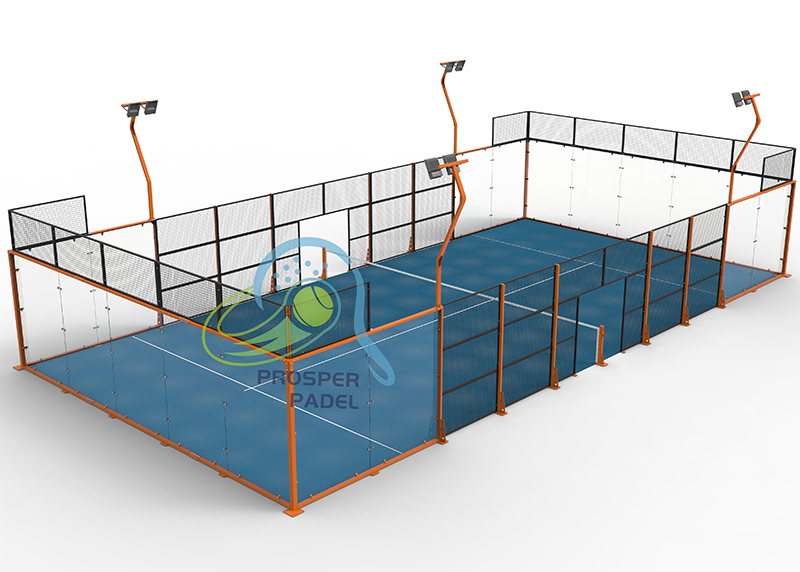
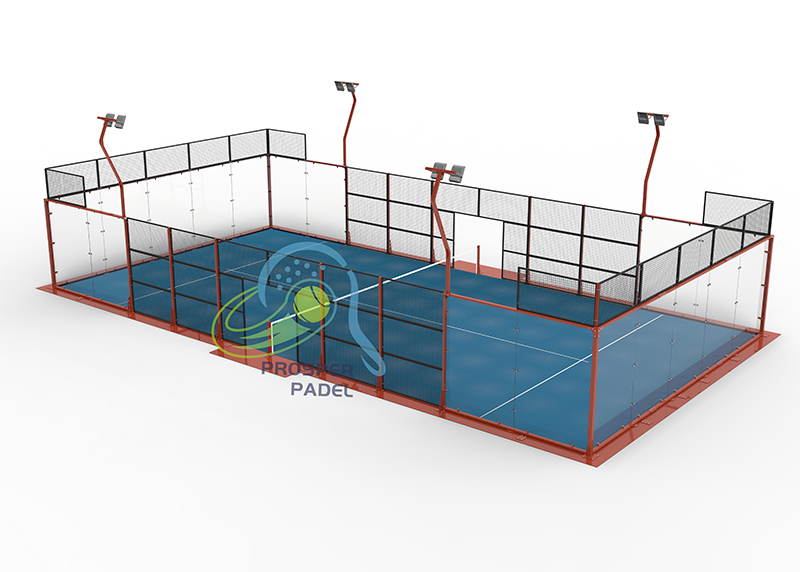
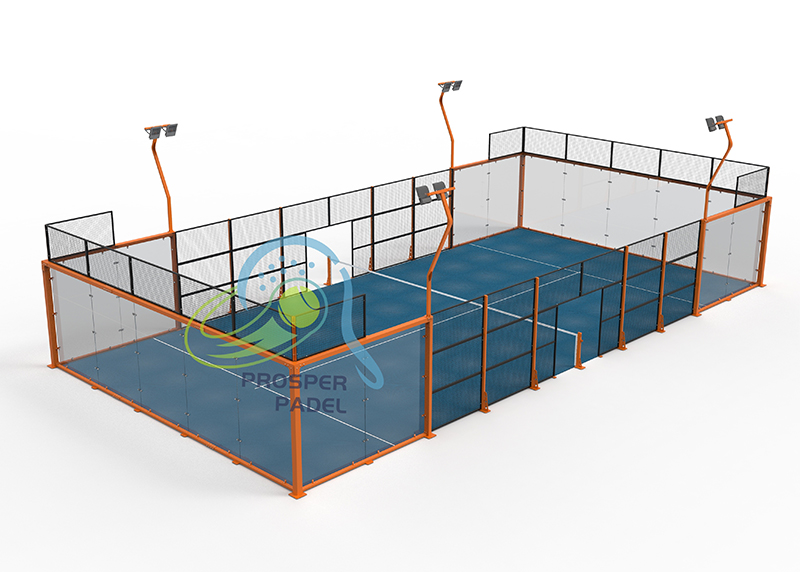
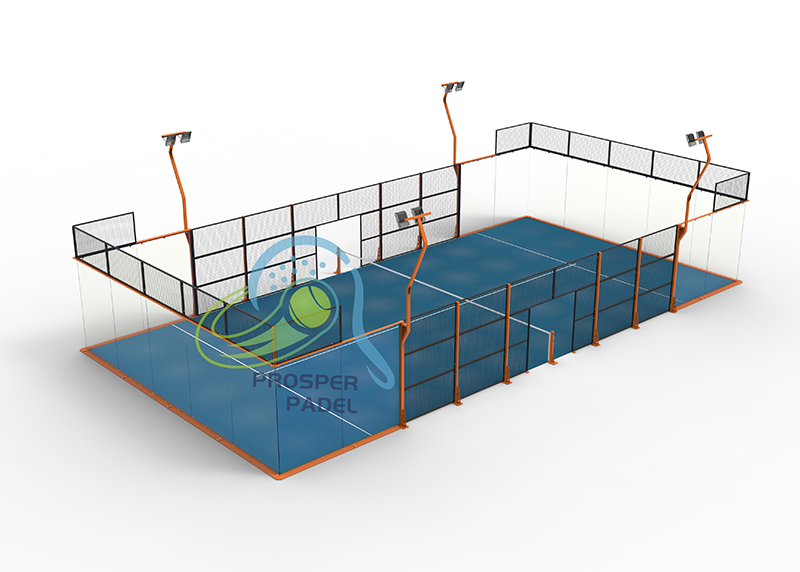
The standard glass thickness commonly used for a panoramic padel court is 12mm tempered safety glass. While 10mm tempered glass is also used in certain padel court designs, 12mm glass is generally preferred for panoramic and full panoramic courts because it provides greater stiffness, more stable rebound characteristics, and better suitability for large glass panels with fewer supporting posts.
The thickness requirement may also depend on the installation environment and national construction guidelines. For example, UK construction guidance specifies 12mm toughened glass for outdoor padel courts, including courts covered by a canopy, while 10mm glass may be considered for indoor installations.
However, choosing the correct glass thickness involves more than comparing two measurements. Glass quality, panel dimensions, structural support, installation accuracy, and local wind loads all influence long-term performance.
For developers planning a panoramic padel court, understanding these factors can help prevent unnecessary costs, installation problems, and premature glass replacement.
This guide explains the differences between 10mm and 12mm padel court glass, relevant safety standards, and the specifications buyers should verify before purchasing.
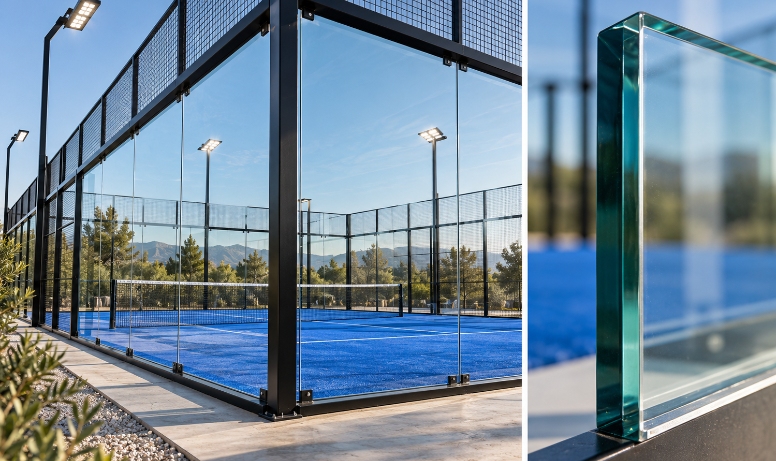
Glass walls serve two essential functions in a padel court: they define the playing enclosure and provide a controlled surface for ball rebound.
Unlike conventional sports fencing, glass panels must withstand repeated ball impacts and occasional physical contact from players.
The structural design of a panoramic court makes glass selection particularly important.
Traditional padel courts typically incorporate more vertical steel posts between glass panels. Panoramic courts reduce these visual obstructions to create wider viewing angles for spectators and cameras.
As a result, some glass panels may rely on different support arrangements, requiring careful consideration of bending resistance, connection details, and structural stability.
Three factors make glass thickness particularly important.
Glass panels experience loads from ball impacts, player contact, wind pressure, and the surrounding structure.
A thicker glass panel generally has greater bending stiffness than a thinner panel of the same material and dimensions.
This reduces deflection under comparable loading conditions.
For panoramic structures with larger unsupported glass areas, limiting excessive movement is especially important.
However, thicker glass does not eliminate the need for proper structural support. Poorly designed connections can still cause damage even when 12mm glass is used.
The glass wall is an active part of padel gameplay.
Players frequently use wall rebounds during defensive and attacking shots, so the surface must provide predictable ball behavior.
Excessive glass movement can absorb more impact energy and potentially influence rebound consistency.
A correctly installed 12mm panel typically provides a stiffer rebound surface than a comparable 10mm panel.
However, the difference depends on the complete wall system, including panel dimensions, fixing positions, gaskets, and frame stiffness.
Panoramic courts use different arrangements of glass panels, steel beams, and supporting posts.
A glass specification suitable for one enclosure design may not be appropriate for another.
For example, a conventional court with regularly spaced structural supports may accommodate a different glass specification from a full panoramic court with fewer intermediate posts.
Glass thickness should therefore be selected alongside the structural design rather than treated as an interchangeable component.
Both 10mm and 12mm tempered glass can be used in padel court construction, subject to the applicable regulations and engineering requirements.
The differences become clearer when comparing their physical properties and typical applications.
| Comparison Factor | 10mm Tempered Glass | 12mm Tempered Glass |
|---|---|---|
| Thickness | 10mm | 12mm |
| Typical Application | Selected conventional and indoor courts | Panoramic, full panoramic, and outdoor courts |
| Bending Stiffness | Lower for equivalent panels | Higher for equivalent panels |
| Approximate Weight per 2 × 3m Panel | 150kg | 180kg |
| Ball Rebound | Depends on mounting and structural support | Generally less panel deflection under equivalent conditions |
| Material Cost | Generally lower | Generally higher |
| Handling Requirements | Heavy lifting equipment may be required | Greater lifting and handling demands |
| UK Outdoor Court Guidance | Not recommended | Required by current guidance |
Note: Panel weights are approximate, based on a glass density of 2,500kg/m³. Actual finished weights vary with dimensions and processing. Requirements differ by country and project.
Yes, 10mm tempered glass can be suitable for certain court configurations, particularly indoor installations where the applicable standards and structural design permit it.
Its lower weight can reduce some material and handling costs.
For a typical 2 × 3m panel, 10mm glass weighs approximately 150kg, compared with approximately 180kg for 12mm glass.
This difference becomes significant when transporting and installing multiple panels.
However, lower weight and cost should not be the primary reasons for selecting 10mm glass.
The panel must still satisfy the intended loads, support conditions, relevant safety standards, and applicable construction requirements.
For panoramic padel court construction, 12mm tempered glass offers several practical advantages.
First, its greater stiffness helps limit deformation where glass panels have fewer intermediate supporting posts.
Second, its reduced deflection can contribute to consistent ball rebound.
Third, 12mm glass is widely adopted in commercial panoramic court specifications, making it a familiar option for project designers, installers, and equipment suppliers.
This does not mean that every 12mm glass panel performs identically.
Glass manufacturing quality, dimensional accuracy, fixing methods, and structural engineering remain essential.
For most new panoramic padel court projects, 12mm tempered safety glass is a sensible specification to evaluate first, subject to local requirements.
Different organizations provide guidance on court design and safety, but their requirements should not be confused.
The International Padel Federation establishes the official playing rules and court requirements for padel.
The FIP Rules of Padel, applicable from January 1, 2026, specify that court walls must provide a uniform playing surface and consistent ball rebound.
They also require glass courts to comply with the relevant tempered or plate-glass standards referenced in the FIP Courts Homologation Annex.
Importantly, the main Rules of Padel document does not state one universal 10mm or 12mm thickness requirement for every court configuration.
Therefore, describing 12mm glass as a universal FIP requirement without considering the relevant homologation specifications would be inaccurate.
Buyers developing competition venues should verify the applicable FIP requirements together with local construction standards.
The United Kingdom provides a more specific example.
The Lawn Tennis Association (LTA) and Sports and Play Construction Association (SAPCA) publish technical guidance for padel court construction.
Current guidance specifies:
12mm toughened safety glass for outdoor courts.
12mm glass for courts covered by a canopy.
10mm glass may be considered for certain indoor courts.
Suitable certification and identification for glass panels.
Proper countersunk fixings and secure structural support.
These requirements reflect the importance of weather exposure and structural safety in UK court construction.
For international buyers, the key lesson is that glass selection must account for the destination country's technical requirements.
EN 12150-1 is an important European product standard for thermally toughened soda-lime silicate safety glass.
It covers relevant manufacturing and performance characteristics, including fragmentation behavior.
Tempered glass undergoes controlled heating and rapid cooling, creating a stress profile that improves its mechanical resistance compared with ordinary annealed glass.
If breakage occurs, tempered glass typically fragments into many relatively small pieces rather than the large, sharp shards associated with ordinary annealed glass.
However, tempered glass is not unbreakable.
EN 12150 compliance also does not, by itself, demonstrate that an entire padel court structure is correctly engineered or approved for a particular project.
Buyers should request appropriate test documentation and confirm that the specified glass meets the local regulatory requirements.
Thickness is only one part of a complete panoramic padel court glass specification.
Several additional details can have a significant impact on installation quality and long-term performance.
Many commercial panoramic padel courts use glass panels with nominal dimensions of approximately 2 × 3 meters.
The exact manufactured dimensions may be slightly smaller to accommodate installation clearances and connection requirements.
Some typical panoramic configurations use 18 glass panels, although the total number and individual sizes depend on the enclosure design.
Buyers should confirm the glass panel schedule and technical drawings before placing an order.
This is particularly important when purchasing replacement panels for an existing court.
Tempered glass panels should have properly processed edges.
Poorly finished edges, chips, or scratches can create stress concentrations and increase the risk of breakage.
Flat polished edges are commonly specified for high-quality panoramic court glass.
Glass panels should also have acceptable flatness, clear visibility, and surfaces suitable for uniform ball rebound.
Many panoramic court systems use mechanical fixings that pass through pre-drilled holes in the glass.
The locations and dimensions of these holes must match the structural design.
Countersunk fixings are commonly used to avoid protruding hardware that could interfere with ball rebound or player safety.
Importantly, drilling and edge processing must be completed before the glass is tempered.
Tempered glass generally cannot be cut or drilled after the tempering process without risking breakage.
This makes accurate manufacturing drawings essential.
Glass should not be installed with inappropriate direct contact against rigid steel components.
Suitable gaskets, sleeves, pads, and approved fixing details can help accommodate tolerances and reduce localized stresses.
Some commercial systems use neoprene support pads beneath the glass.
The gasket arrangement should follow the approved structural design, including bolt tightening specifications and required clearances.
Incorrect installation can create concentrated stresses that increase the risk of breakage.
Buyers should confirm that glass suppliers can provide suitable documentation.
Depending on the project, this may include:
Tempered glass product specifications.
EN 12150 compliance documentation or equivalent applicable test evidence.
Thickness and dimensional inspection results.
Glass identification and traceability.
Edge-processing and drilling drawings.
Additional testing documentation where required.
For projects with stricter specifications, heat-soaked tempered glass may also be considered to reduce the risk of certain types of spontaneous breakage, although it does not eliminate every possible failure mechanism.
Yes. Glass thickness influences transportation, handling, and certain installation requirements.
A typical 12mm panel measuring approximately 2 × 3 meters weighs about 180kg.
Because of this weight and the fragility of glass edges, installation requires appropriate lifting equipment, trained personnel, and careful handling procedures.
Glass panels should be protected during international shipping and inland transportation.
Suitable racks, protective separators, edge guards, and secure packaging help reduce damage during loading and transit.
For overseas projects, buyers should confirm packaging arrangements and responsibilities for damaged components.
During installation, each panel must be correctly positioned relative to the surrounding structure.
Installers should verify:
Panel alignment and verticality.
Uniform clearances between adjacent panels.
Correct location and condition of fixing hardware.
Appropriate gasket placement.
Suitable tightening procedures.
Protection of exposed edges and corners.
The internal glass surface should also align properly with adjacent enclosure elements to maintain predictable ball rebound.
Glass panels transfer loads to their supporting steel structure and, ultimately, the foundations.
The design must account for the combined effects of glass weight, wind, and other relevant loads.
For outdoor panoramic courts, wind loading is particularly important because the large glass surfaces form a substantial part of the enclosure.
Changing from 10mm to 12mm glass increases weight, but it does not automatically make an existing frame or foundation suitable for the revised design.
Any significant specification change should be reviewed by the responsible engineer.
The appropriate choice depends on the intended court configuration and project location.
Where local regulations permit, 10mm tempered glass may be considered for a suitably engineered indoor court.
However, 12mm glass may still be selected for greater stiffness and compatibility with the chosen system.
For exposed outdoor installations, 12mm tempered glass is a common and generally preferred option.
Buyers should also evaluate wind-load calculations, steel profiles, fixing arrangements, corrosion protection, and foundation requirements.
A 12mm specification is widely used for full panoramic courts, especially those intended for commercial clubs and professional events.
However, reduced structural posts mean that support arrangements and installation details require particular attention.
Glass thickness should never be selected solely on the assumption that a thicker panel can withstand all environmental conditions.
In exposed locations, the complete enclosure must be designed for the relevant wind pressures and structural loads.
Additional engineering, stronger structural components, or different anchoring arrangements may be required.
Several purchasing mistakes can lead to unnecessary maintenance costs or installation difficulties.
Choosing glass based only on price
Lower material prices may be attractive, but unsuitable thickness or inadequate processing can create higher long-term costs.
Assuming 12mm glass cannot break
Tempered safety glass is designed to provide greater strength and safer fragmentation behavior, not absolute resistance to breakage.
Ignoring panel dimensions and hole positions
Replacement glass must match the actual structural configuration. Similar-looking panels are not necessarily interchangeable.
Overlooking local construction requirements
A glass specification accepted in one country may not meet the applicable requirements in another.
Failing to confirm installation responsibilities
Even appropriately manufactured glass can be damaged by poor handling, incorrect tightening, or inadequate structural alignment.
Before purchasing, buyers should request clear specifications, installation drawings, and suitable compliance documentation.
Not universally. Requirements vary by country, court configuration, and applicable construction or competition standards.
However, 12mm tempered glass is commonly specified for panoramic courts, and UK guidance requires it for outdoor and canopy-covered installations.
Its suitability depends on the local standards and engineered design.
For UK outdoor courts, current guidance specifies 12mm glass rather than 10mm.
Buyers should always verify the requirements in the country where the court will be installed.
For otherwise comparable panels, 12mm glass generally offers greater bending stiffness and reduced deflection.
However, the overall strength and safety of a court wall also depend on glass quality, dimensions, support conditions, and fixing details.
Thermally toughened safety glass is widely used.
Many professional panoramic court specifications call for 12mm tempered glass manufactured to relevant safety glass standards such as EN 12150.
Other glass systems may be permitted or required depending on local regulations and approved designs.
There is no universal replacement interval.
Service life depends on glass quality, installation conditions, environmental exposure, impacts, and maintenance.
Glass panels should be inspected regularly, particularly around edges, fixing holes, and structural connections.
Any cracked or damaged panel should be assessed immediately, and the affected court taken out of use until it is safe.
Not without checking compatibility.
The thicker panel has additional weight and may require different fixings, gaskets, or structural clearances.
A qualified professional should confirm that the existing court system can accommodate the change.
For most commercial panoramic padel court projects, 12mm tempered safety glass is the preferred starting specification because of its stiffness, established industry use, and compatibility with many panoramic enclosure designs.
However, glass thickness should not be considered independently of panel dimensions, fixing methods, steel structures, foundations, and local construction standards.
A well-designed panoramic court relies on the performance of the complete enclosure system rather than any individual component.
For international buyers, the best approach is to request detailed glass specifications and structural documentation before confirming a supplier.
Tianjin Juzhixin Sports uses 12mm tempered safety glass in its Full Panoramic Padel Court JZX-10 and Max Pro Panoramic Padel Court configurations.
For new commercial facilities, buyers can also explore Juzhixin's one-stop sports venue solutions to coordinate court structures, materials, and supporting facilities.
Contact Juzhixin Sports to discuss the appropriate panoramic court configuration and glass specifications for your project.
Click To Get Your Exclusive Plan
Tianjin Juzhixin Sports Technology Co., Ltd is an innovative sports technology and import and export sales enterprise based in Tianjin and radiating its business worldwide. It is dedicated to empowering the development of the sports industry with technology
Contact Us
HOT Products

+86 189 2070 7687
Huamao Building, Binhai New Area, Tianjin
Copyright @ Tianjin Juzhixin Sports Technology Co., Ltd All Rights Reserved | Sitemap
| Powered by